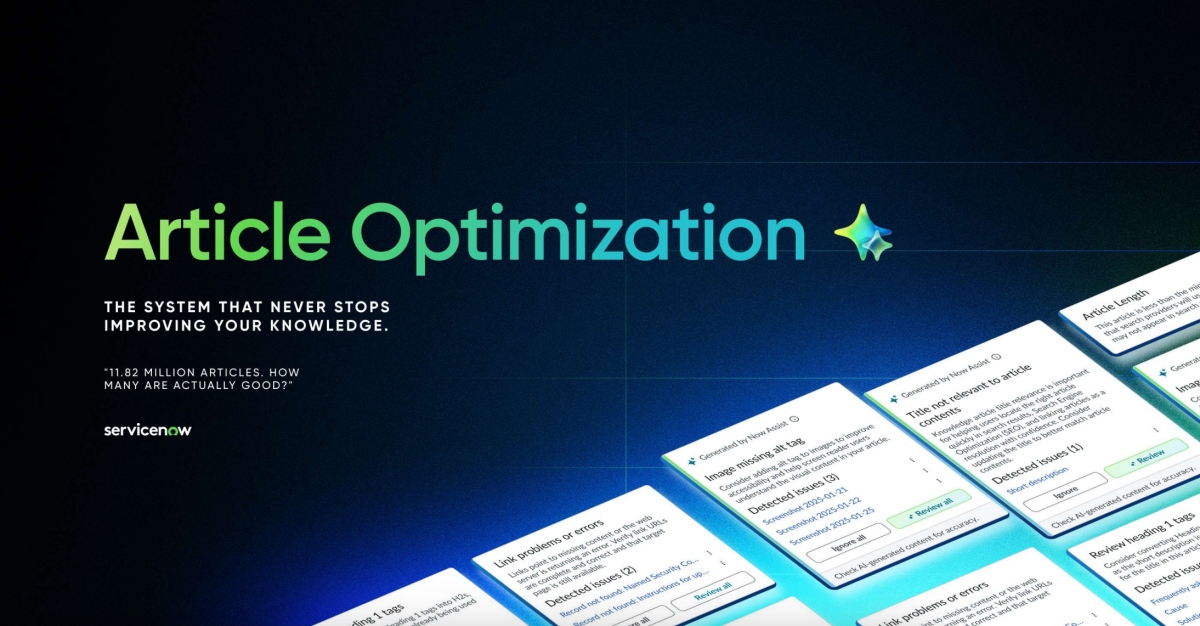
Article Optimization
ServiceNow Article Optimization is an AI-assisted system that helps organizations continuously improve the quality of...

Yizhen Chen specialises in designing enterprise products that simplify information management and support better digital workflows. With a strong foundation in human-centred design, she creates experiences that make complex systems feel approachable and purposeful.
Thank you. My name is Yizhen Chen, and I’m a product designer focused on enterprise UX, knowledge management, and digital workflow design.
I was drawn to design because I enjoy making complex systems feel clear and usable. In both my academic background in human-centred design and my professional work in enterprise software, I’ve been interested in how people create, organise, and improve information. That naturally led me to knowledge management, where design can directly improve how people work with large amounts of content.
This recognition is meaningful because it shows that enterprise design can be both practical and innovative.
A lot of enterprise UX work is not about creating flashy visuals. It is about solving complex workflow problems, improving clarity, and helping users complete important tasks with more confidence. Being recognised by the London Design Awards validates the value of that kind of design work.
The award has helped strengthen the visibility of my work in enterprise UX and knowledge management. It also recognises the cross-functional effort behind the project, including design, product, engineering, research, and leadership collaboration.
For my career, it helps establish a clearer professional focus around designing scalable workplace experiences. It has also created more opportunities for professional storytelling and conversations around enterprise design, knowledge workflows, and workplace productivity.
Experimentation helps me turn broad product capabilities into usable experiences.
For Article Optimization, one key challenge was deciding how to present content improvement opportunities without overwhelming users. I explored different ways to group issues, prioritise guidance, and explain why each recommendation mattered. Through iteration with product, engineering, and research partners, the experience became more structured, actionable, and easier to use.
I often take inspiration from how people organise information outside of software — notebooks, checklists, annotations, and personal task systems.
These everyday behaviours reveal how people naturally create order from complexity. For knowledge management products, that kind of observation can inspire more intuitive ways to structure digital workflows.
I wish more people understood that design is not just the final interface. It is the reasoning behind the interface.
In enterprise UX, even a small interaction can reflect many decisions around user needs, technical constraints, accessibility, scalability, and business goals. A simple final design often comes from a very complex decision-making process.
I try to ground design discussions in user needs and product goals rather than personal preference.
When there are different stakeholder expectations, I focus on identifying the core problem and explaining the tradeoffs clearly. Staying true to my ideas does not mean defending one solution at all costs. It means protecting the user experience while staying open to better approaches.
The biggest challenge was making complex content quality guidance feel simple and actionable.
Article Optimization included multiple types of signals, such as structure, accessibility, links, freshness, duplication, and other article-quality considerations. I focused on organising these signals into a clear hierarchy, so users could quickly understand what needed attention, why it mattered, and what to do next.
Close collaboration with product and engineering helped ensure the design was both useful for users and feasible to build.
I usually step away from the screen and return to the user's problem. Walking, sketching, reading, or looking at how other systems organise information often helps me reset.
For me, creativity is not only about inspiration. It is also about finding clarity.
I bring clarity, empathy, and responsibility into my work.
Clarity helps users understand complex workflows. Empathy helps me respect users’ time and attention. Responsibility reminds me that workplace tools should help people make better decisions without adding unnecessary confusion.
Become strong at explaining your design decisions.
Good designers do more than create polished screens. They understand the problem, communicate their reasoning, collaborate across functions, and connect design decisions to user and business impact.
I would also encourage aspiring designers to become comfortable with ambiguity. Many important design problems do not come with clear instructions.
I would love to collaborate with Don Norman because his work has deeply shaped how designers think about human-centred design, usability, and the relationship between people and systems.
His perspective is especially relevant to enterprise products, where the challenge is not only whether a system works, but whether people can understand and use it effectively.
I wish more people would ask: “How do you design enterprise experiences that users can trust?”
My answer is that trust comes from clarity and control. Users need to understand what the product is helping them do, why something matters, and what choices they have.
In my work on knowledge management, I try to make complex guidance feel clear, actionable, and grounded in real workflows.
Explore with Zhenhua Chen in Creating Calm Through Industrial Design in his interview for winning in the 2026 London Design Awards here.