Spacia
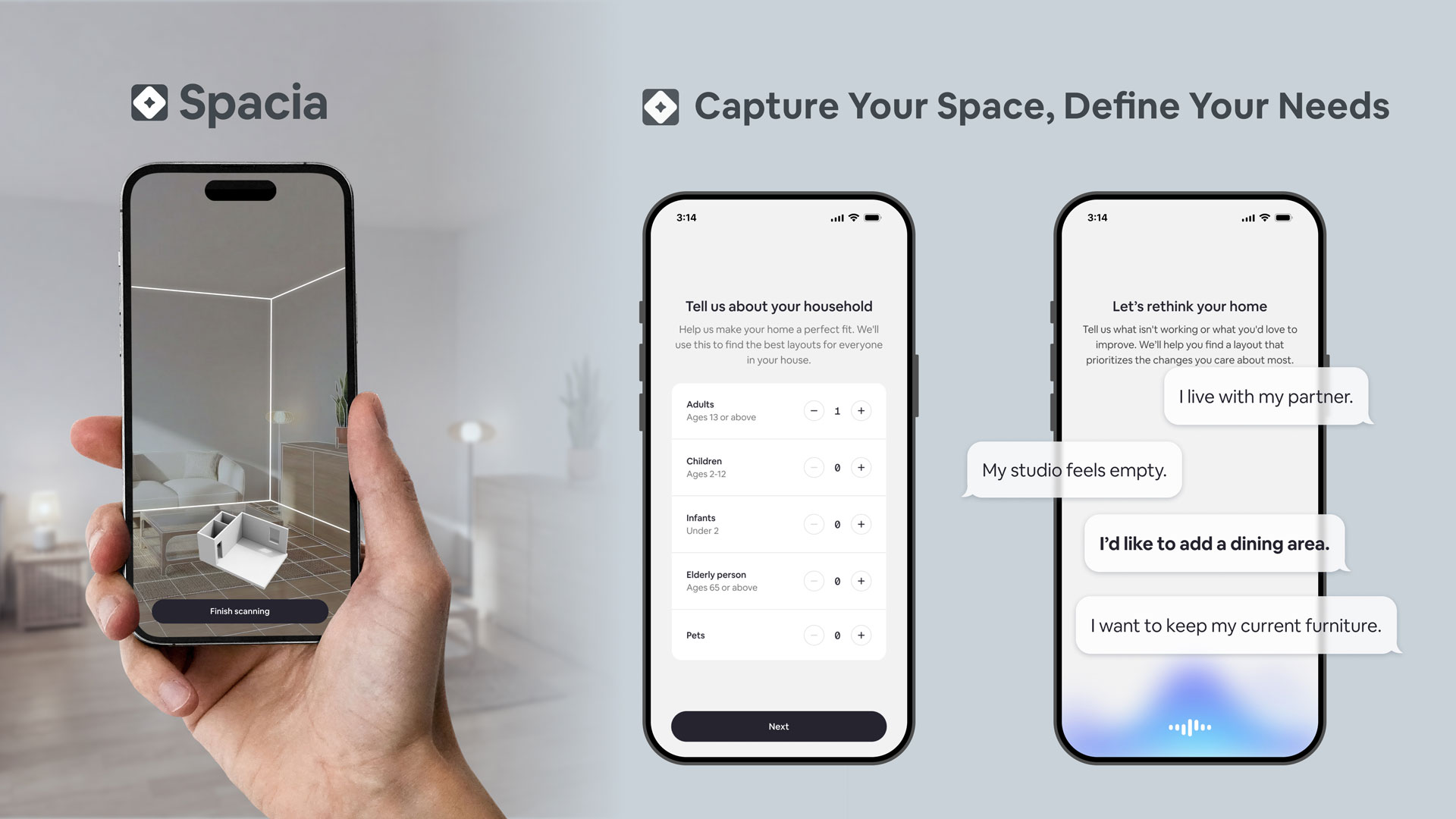
Spacia is an AI-powered spatial analysis and layout design platform that introduces spatial intelligence into...
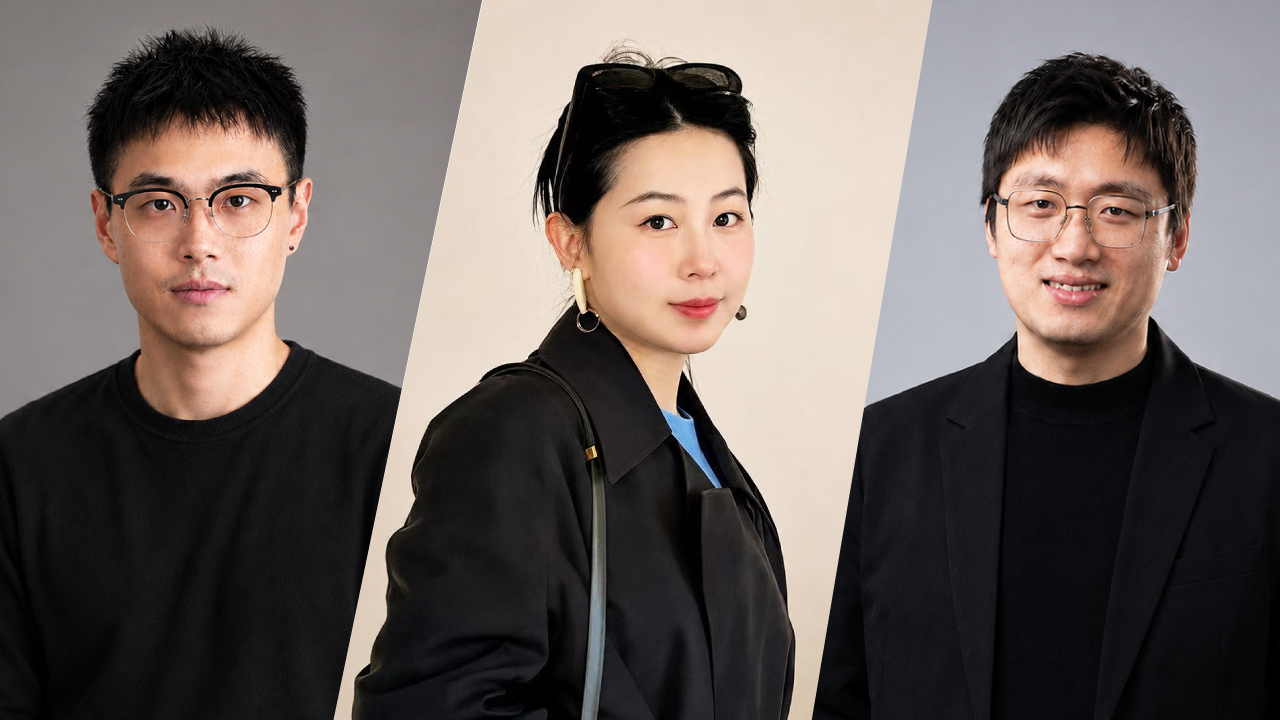
Product designers Ziwei Deng, Junyue Hua, and Shixiao Wang are the creators of Spacia, an AI-powered spatial intelligence concept that combines architecture, UX/UI, and interaction design to reimagine home optimization through intuitive, human-centered experiences.
Ziwei: Thank you. I am a product designer with a background in architecture. My journey began in architecture, where I learned to see space not as a container, but as a living system shaped by movement, behavior, memory, and emotion. Later, product design gave me another medium through which to shape human experience. Spacia reflects this cross-disciplinary path, using AI to bridge physical space, digital interaction, and everyday life.
Junyue: I’m a product designer with over a decade of experience building digital systems. My career began with a focus on mobile hierarchy and design tokens, but it has since evolved into exploring how AI and spatial intelligence can transform our physical environments. It’s been a ten-year masterclass in staying curious while the industry shifts from pixels to three-dimensional contexts.
Shixiao: I’m a product designer focusing on UX/UI and human-centered interaction design. My work explores how technology, especially AI, can improve everyday experiences. My journey began with an interest in solving practical problems through design, which gradually led me to spatial design, human-computer interaction, and AI-driven solutions.
We entered this competition to see how our work on non-traditional, 3D interfaces would resonate with the broader design community. Winning is a powerful validation of that direction. Professionally, it proves there is a hunger for more immersive design, and personally, it marks a great milestone after ten years in the field.
Ziwei: Spacia was born from a simple observation: a home can look beautiful and still fail the people who live in it. Many design tools focus on visual style, but spatial quality is often invisible—it lives in circulation, comfort, safety, light, and daily routines. Spacia uses AI to reveal these hidden conditions and suggest improvements.
In today’s industry, it represents a shift from image-driven design to intelligence-driven design that understands how life actually unfolds in space.
Junyue: The project was born from a desire to take complex spatial intelligence—technologies that often feel confined to research labs—and make it practical for the living room. It represents a necessary shift in the industry: moving from designing "flat" interactions to building systems that truly understand physical context.
In an era where AI is everywhere, I believe this work proves that technology is most successful when it stops being a distraction and starts helping us better navigate the physical world we actually live in.
Shixiao: Spacia was inspired by the fact that many people live with inefficient or unsafe layouts without realizing it. It represents a new opportunity in today’s AI-driven industry by making spatial intelligence accessible, measurable, and actionable for everyday users, not only professionals.
The project's success came from balancing technical depth with exceptional visual clarity. While many spatial tools become cluttered with data, I leaned into a "less but better" approach, using a disciplined system of padding and hierarchy to make 3D reconstruction feel as intuitive as a standard mobile app.
By treating AI as an invisible utility for home optimization rather than a technical showcase, we created a bridge between advanced spatial intelligence and everyday human needs.
The most significant challenge was translating complex 3D reconstruction data into a clean, intuitive mobile experience. Spatial intelligence tools often suffer from "information overload," where technical data overshadows their actual utility.
To overcome this, I focused on a highly disciplined design system, using precise padding and a clear hierarchy of design tokens to ground the 3D elements. By stripping away visual noise and focusing on the core user flow, I was able to turn a dense technical process into a simple, guided interaction that felt accessible rather than intimidating.
Ziwei: This award is a meaningful recognition of my design ability and cross-disciplinary perspective. More importantly, it affirms my belief that the future of design will not be confined to single disciplines. I hope this achievement helps build my visibility in AI-driven design and opens opportunities to collaborate with engineers, AI experts, and spatial thinkers.
My ideal next step is to bring Spacia closer to reality and explore how this idea can create a real-world impact.
Junyue: I hope this recognition creates more room for high-stakes experimentation within my team. It signals that we should lean into "future-state" design rather than simply making incremental improvements. We’ve already seen greater internal buy-in for projects that prioritize long-term innovation over safe, standard solutions.
Shixiao: We hope this recognition brings more attention to design that uses technology to support better living rather than increased consumption. It has already sparked conversations with designers and potential collaborators while reinforcing our long-term goal of building meaningful, human-centered products with real impact.
The reaction from stakeholders has been one of shared validation. We were navigating a high level of technical complexity with spatial AI, so the most rewarding feedback was hearing that the technology finally felt "invisible."
A standout moment for me came during a late-stage review when a primary stakeholder realized that a task which had previously taken hours of manual input could now be completed in seconds. That shift—from focusing on the "how" of the technology to the "wow" of the experience—confirmed that we were on the right track.
Ziwei: My advice is to begin before you feel fully ready. Creative work often becomes clear only through making. In the AI era, the distance between idea and prototype is becoming shorter, which means designers can test, learn, and iterate faster than ever. Do not wait for the perfect time or complete certainty.
Start with a meaningful question, build momentum through action, and allow the project to reveal its own direction through feedback, reflection, and persistence.
Junyue: Master the fundamentals so you have the freedom to break them. You can't design the future of spatial AI if your basic padding, typography, and design tokens are sloppy. My advice is to document your failures as clearly as your successes. The "why" behind a design is always more compelling to a jury than the final render alone.
Shixiao: Focus on solving a real problem. Award-worthy projects are not only visually polished, but also have a clear perspective and respond to a genuine need. Don’t be afraid to challenge assumptions, because strong ideas often come from questioning what people usually take for granted.
Ziwei: The creative industry is being reshaped by AI. I see designers moving toward a more hybrid role, where they not only imagine experiences but also help build them. This is both empowering and demanding. AI lowers technical barriers, but it also raises the standard for original thinking.
In the future, I hope to position myself as a designer who connects vision with execution—someone who can think spatially, design systemically, and use AI to bring meaningful ideas to life.
Junyue: We are moving away from designing for screens and toward designing for environments. The future is "context-aware" design—systems that understand where a user is and what they need before they even ask. I’m positioning my work at the intersection where 3D reconstruction and AI make digital interfaces feel like a natural part of the world.
Shixiao: The creative industry is moving toward more intelligent and adaptive AI-powered systems. I hope to help shape how these technologies are applied in human-centered ways, ensuring they remain meaningful, ethical, and grounded in real-life needs.
Ziwei: For people who hesitate to enter competitions, I would say that participation itself is a form of practice. Submitting work forces you to clarify your thinking, sharpen your story, and understand the value of your own ideas. You may not win every time, but each attempt gives you feedback and perspective.
Confidence is not something you wait for; it is built through exposure, iteration, and courage. Once you begin, your design voice becomes stronger.
Junyue: Think of every submission as a way to sharpen your logic. Even if you don’t walk away with a trophy, the process of articulating your vision and evaluating your own work is one of the fastest ways to build professional confidence. Don't wait for permission to show your work; the act of competing is where growth happens.
Shixiao: You don’t need a perfect project to begin; you need a meaningful idea. Competitions are not only about winning, but also about refining your thinking and learning to communicate your work clearly. Confidence comes from doing, not from waiting until everything feels ready.
Ziwei: The AI era is not only a technological shift, but also an imaginative one. It gives us new tools to question old boundaries and create experiences that were previously difficult to realize. But technology alone is not enough. We still need empathy, taste, judgment, and human intention. The opportunity ahead is to use AI not just to produce more, but to create more meaningfully.
Junyue: Look for inspiration in systems that have nothing to do with software. Whether it’s architectural heritage or the delicate balance of an ecosystem, the best design solutions often come from observing the physical world. Let’s stop designing in a bubble and start building tools that reflect real-world complexity.
Shixiao: Stay curious and honest with your ideas. Trends change quickly, but meaningful design comes from understanding people deeply, not simply from following what is popular.
Ziwei: I would like to thank my two teammates. Spacia was not created from a single perspective, but through collaboration, discussion, and a shared belief in the idea. A project like this requires problem framing, spatial reasoning, product thinking, interaction design, and storytelling.
I am grateful for their support and contributions throughout the process. This award recognizes not only the final outcome, but also the collective effort that helped transform an abstract idea into a complete vision.
Junyue: This achievement belongs to the engineers and partners who treated my "impossible" ideas as technical challenges rather than roadblocks. Design is a collaborative process, and I’m grateful for the teammates who challenged me to ensure every detail served a functional purpose.
Shixiao: I’d like to dedicate this achievement to my teammates and collaborators. The project reflects a shared vision, and it would not have been possible without everyone’s collective effort, trust, and belief in the idea.
A seamless blend of AI and spatial reconstruction that transforms complex home optimization into an intuitive, almost invisible experience.
Ziwei: Next, I hope to continue bringing Spacia to more design competitions and award platforms because I believe it explores a new and meaningful direction. I have not seen many products approach home design through the lens of AI-driven spatial intelligence.
Beyond recognition, my larger goal is to move the project closer to implementation. I hope to collaborate with engineers, programmers, and AI experts to further develop Spacia and eventually turn it into a real product.
Junyue: I’m currently refining my work in spatial intelligence for upcoming international design competitions such as IDEA and A' Design. This year is also about personal growth through travel. I’ll be working remotely across Spain and Portugal to study how European architectural principles can be translated into more human-centered digital products.
Shixiao: We are continuing to develop Spacia and exploring how it can become a real product for everyday use. We are also interested in expanding this direction into broader applications that combine AI, spatial design, and human-centered systems to create more meaningful living experiences.