tapouts “Session Recap” Email Redesign
tapouts is a Los Angeles-based educational startup offering weekly group coaching for kids and teens....

Focused on digital experiences that improve real-world outcomes, Ellie Mineta designs systems to enhance education and mental health. Her work balances clarity, emotional engagement, and operational efficiency for children’s programs.
My name is Ellie Mineta, and I’m a visual designer working at the intersection of digital experience, education, and mental health.
I currently design scalable, emotionally engaging communication systems for a live, group-based platform that supports children through structured programs focused on confidence, emotional regulation, and performance under pressure.
My background spans large-scale consumer platforms and early-stage startups, focusing on designing systems that balance human connection with growth and operational efficiency. I am very interested in design that helps improve real-world outcomes.
Across digital products, communication with users has become increasingly critical from both retention and lifetime value perspectives. I submitted this work to demonstrate how design alone, without changing the underlying content, can significantly improve the quality of that communication.
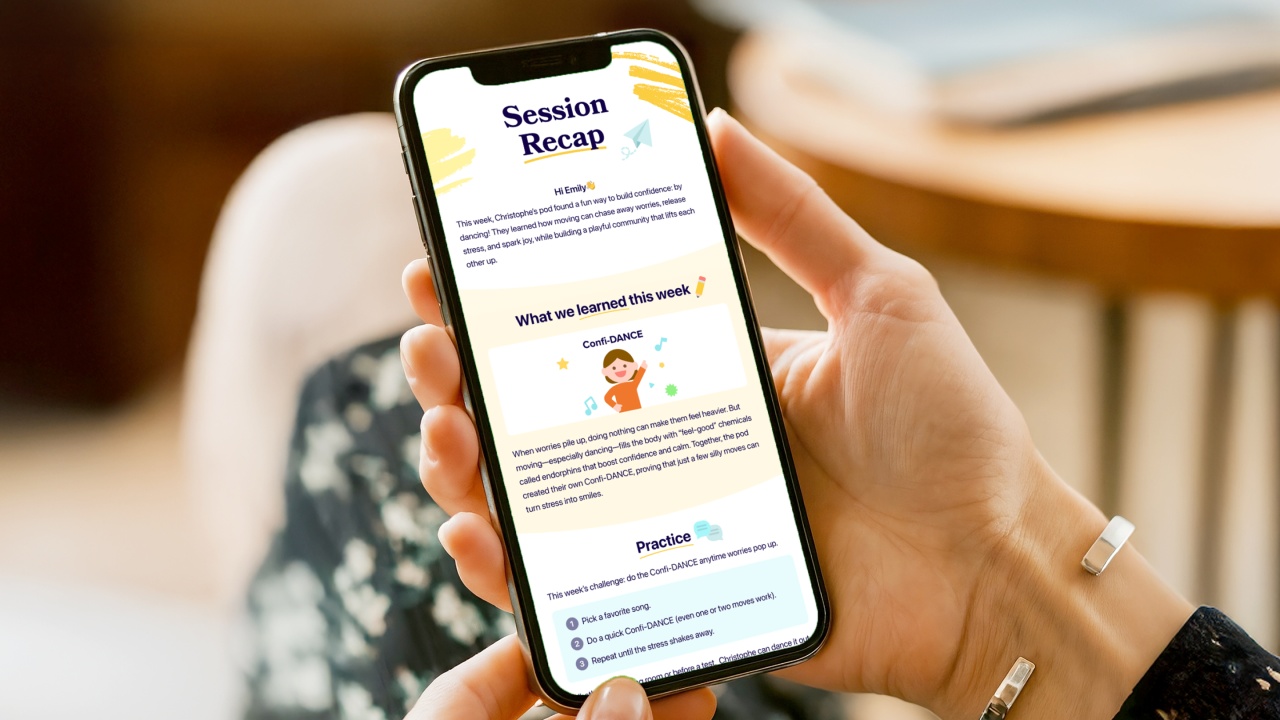
People’s lives are busy, and attention is very limited nowadays. Through simple illustrations and playful yet thoughtful graphics, this email series aimed to clearly communicate with users regarding how we are helping them, improving clarity, increasing engagement, and supporting long-term user commitment.
The project was inspired by a simple question: how do we help children reflect on progress in a way that feels encouraging, not evaluative?
Instead of presenting outcomes as metrics, the design reframes progress as a shared journey between the child, their family, and the program. In addition to highlighting progress, the emails also share practical tips that families can apply at home, helping extend the experience beyond the program itself. This approach reflects a broader shift in the industry toward emotionally intelligent design, where success is measured by long-term engagement and trust rather than short-term conversion.
What sets this project apart is its ability to deliver personalization and emotional resonance at scale without adding complexity to the system.
The design integrates seamlessly into an existing live, group-based model while increasing perceived value and lifetime engagement for users. Every decision was made with scalability in mind to ensure the experience could grow across different ages, needs, and markets without fragmenting the core platform.
One key challenge was creating a consistent series that felt familiar and reliable, so users would recognize it as part of an ongoing journey for their children, while still making it immediately clear that each message contained new and unique content.
Another challenge was designing for clarity within a limited time and attention. The emails were intentionally structured so they could be understood in under a minute, using visual hierarchy and contrast to guide readers through the content quickly.
Because this was an email product, maintaining quality and readability across different email platforms in both light and dark modes was critical. I worked closely with developers to test extensively across environments, iterating on the design to ensure consistency, accessibility, and visual integrity.
This project helped demonstrate the impact of design and graphics not only to me, but also to the broader team. By approaching visuals as a way to empathize with families while reflecting the brand, we were able to communicate our message clearly and meaningfully to the audience.
It reinforced my belief in the power of design as a strategic tool, and it motivates me to continue pursuing projects that place strong trust in design and brand as drivers of engagement and understanding.
The response from families and internal stakeholders was overwhelmingly positive. Parents shared that the experience helped them better understand their child’s progress, while children felt seen and motivated rather than judged.
Internally, the project became a reference point for how design can drive retention and engagement without increasing operational burden.
My advice would be to focus on understanding the system you’re designing for, not just the surface-level problem. I feel that strong design work comes from asking deeper questions and grounding creative decisions in real constraints.
I also find that learning how to communicate the impact of your design work is key. The ability to articulate why your work matters is just as critical as the work itself, especially for platforms that specific communities engage with. Be open to change, but don't forget how your work can create positive change for others!
The creative industry is increasingly expected to deliver measurable impact alongside engaging storytelling, especially with the evolving attention spans and needs of various platforms. Designers are becoming strategic partners rather than service providers, so I aim to position myself at this intersection, where creativity, data and human insight come together to engage with communities I care about.
Even with limited experience, awards should be seen as documentation of your creative achievements. If your work has made a real difference, it deserves to be shared with others since competitions are first and foremost about sharing ideas.
Start by framing your work around impact and intent rather than polish. Confidence grows when you understand the value of your contribution and the creative values you care about.
Creativity thrives when we take responsibility for outcomes, not just ideas. Thoughtful design has the power to shape behavior, systems, and lives.
Stay curious, stay rigorous, and don’t underestimate the long-term impact of small, well-considered decisions!
This recognition is dedicated to the families and children who trusted us with their stories and challenges, as well as the cross-functional teams who believe that meaningful design can scale.
A design-driven approach that transforms everyday email communication into a more meaningful and supportive experience for users and their families.
I’m continuing to focus on designing platforms that support children and families at scale, while exploring opportunities to apply these principles across new, global outlets with my team.
I am excited about our next steps in providing quality communication to our users and look forward to how I can expand on the positive changes that joyful design can bring to a growing community.
If you're looking for more creative insights, click here to read Behind the Screen Worlds: David Mateo González Shares His Visual Storytelling Through VFX.