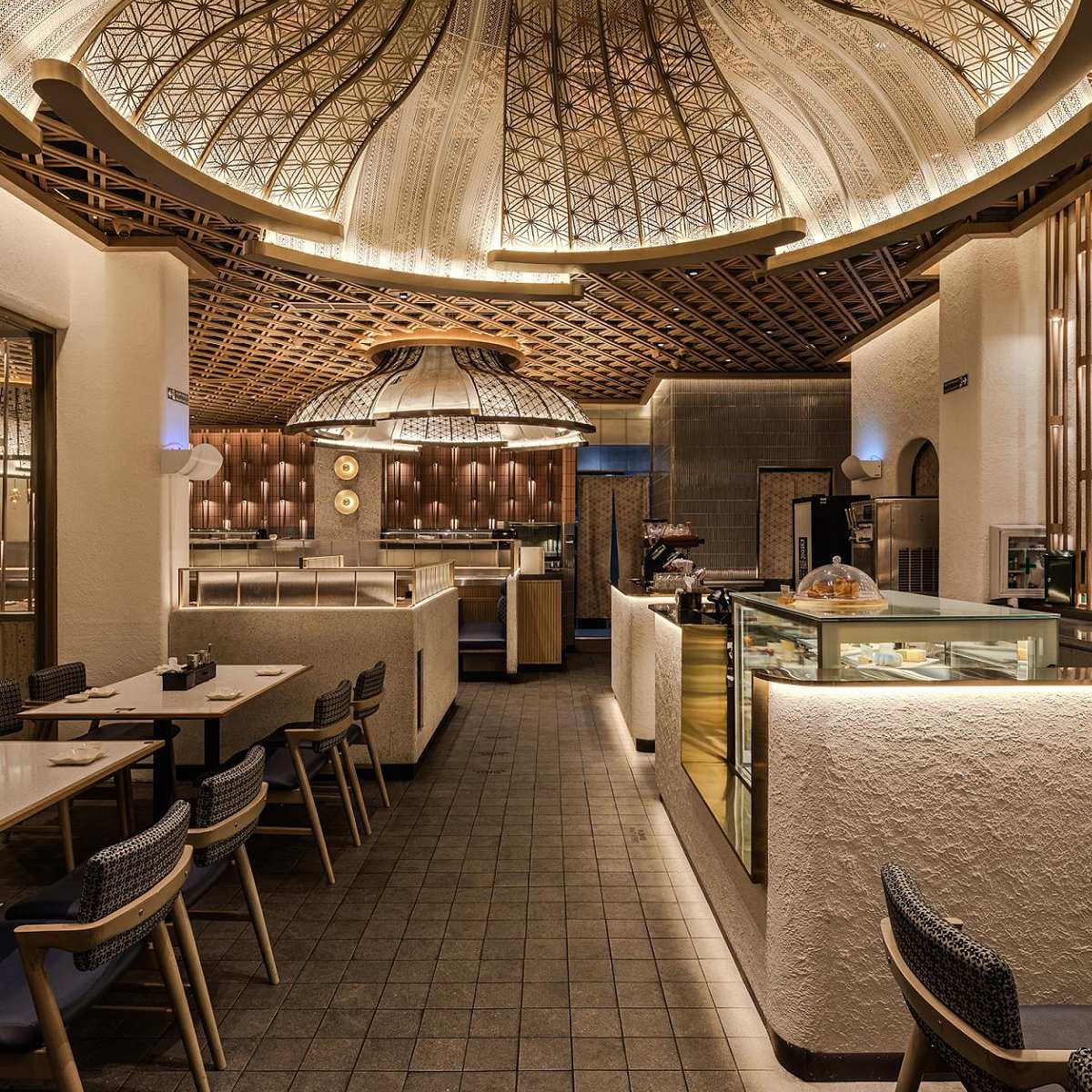
MoMo.Co.,Ltd. Creates a Refined Dining Environment for Sushi Tei Jawa
SEPTEMBER 28, 2026

Anqi Wang: I hold a Bachelor of Architecture degree from SCI-Arc and currently serve as an Architectural Job Captain at a renowned firm based in Santa Ana.
Ruijing Sun: I am Ruijing Sun, a graduate of Columbia University with a Master of Science in Advanced Architectural Design. Currently, I am working as an architectural designer at OLI Architecture.
Yue Liang: I am Yue Liang, a 2022 graduate of the University of Southern California with a Master of Architecture degree. I am currently a Design Professional 1 at ODP Architects, where I contribute to innovative and impactful architectural projects.
Hao Zhou: I hold a Master of Architecture degree from Syracuse University and am currently working at a modular design architecture firm specializing in the "Design, Manufacture, Construction (DMC)" approach. My role allows me to contribute to cutting-edge, integrated solutions in the architectural field.
Anqi Wang: Product design, particularly in furniture, closely aligns with architectural design. I see furniture as a smaller-scale version of architecture, which is why I am drawn to this field.
Ruijing Sun: Having participated in residential interior design, I developed an interest in furniture design throughout the process. I became particularly drawn to how chairs play a pivotal role in shaping the functionality and aesthetic of a home, highlighting their significance in interior design.
Yue Liang: I am deeply interested in both the design of living spaces and how people interact with their interiors, as well as the ways they engage with the products they use.
Hao Zhou: Having designed numerous large-scale buildings, I realized I had overlooked the everyday products that play a crucial role in people's lives.
These smaller items are often more intimately connected to daily experiences, and I believe that thoughtful product design has the power to enhance well-being and bring greater happiness to individuals.
We are a studio that specializes in both architectural and product design. Each member of our team is passionate about life, skilled at finding inspiration in its nuances, and dedicated to infusing every aspect of life into our designs.
Our studio's primary focus is on participating in various competitions, allowing us to build a strong foundation for future growth and innovation.
For us, design is the process of elegantly solving problems. It requires a deep understanding of client needs and market response, followed by crafting solutions that effectively address those needs while engaging users or audiences.
Our favorite type of design reflects the combination of art and industry, creating practical and beautiful solutions for everyday life. Design should address people's problems. We prefer designs that enhance functionality over form.
This approach is simple and clear, with practicality as the primary goal. It utilizes clean lines and simple shapes, making it easy for users to understand. In simple terms, it's about streamlining the process of problem-solving.
Any design that solves people's problems is a good design. If a product is inconvenient to use or wastes resources, it needs to be redesigned. A good design should be both user-friendly and environmentally conscious.
Our design style aims for sustainability, creating products that are both environmentally and user-friendly. We chose wood for its eco-friendly qualities.
Additionally, we were inspired by the shape of the arch in architecture, simplifying the classical arch structure. The result is an efficient, simple, and practical lounge chair.
The design journey starts with a hand-drawn sketch, adding a personal touch, and progresses to precise 3D modeling. As architectural designers, we’ve observed the large span and excellent load-bearing capacity of arch structures and aim to incorporate these elements into furniture design.
We are truly honored to receive this award, which motivates us to keep designing and creating even more meaningful work.
Our country and culture deeply influence our design approach, emphasizing simplicity and functionality. Additionally, our experience in the United States has sharpened our attention to detail and construction, enriching the depth and precision of our designs.
We are truly honored to receive this award, which motivates us to keep designing and creating even more meaningful work.
This award is a meaningful recognition of our journey in furniture design, affirming our approach to blending form and function. It highlights the potential to challenge the boundaries of traditional furniture design while prioritizing eco-friendly principles.
Beyond boosting our confidence, this recognition has opened new avenues for our careers, including opportunities for collaboration. It inspires us to continue experimenting with innovative design concepts, honing our skills, and exploring furniture design as an integral part of architectural interior design.
Creative Problem-Solving: We can enhance life by adding various forms of beauty through innovative and practical design.
Interdisciplinary Collaboration: Designers from different industries can collaborate with experts and engineers across fields, absorbing diverse insights to create more comprehensive and impactful projects.
Social and Environmental Impact: The ability to shape spaces and products that positively impact living environments and promote sustainability is incredibly rewarding, allowing designers to bring lasting change to the world.
We grew up in China, a country with a rich history and remarkable ancient architecture. Subtly influenced by its traditional culture, we strive to blend heritage with modern innovation, respecting history while embracing future trends. The rapid urbanization and cultural diversity in China have further enriched the design field, enabling a dynamic fusion of various influences.
Moreover, the growing emphasis on sustainability has led many designers to adopt eco-friendly practices and sustainable solutions. This unique combination of historical legacy, cultural depth, and forward-thinking innovation makes China's design industry both vibrant and influential on the global stage.
In the next 5-10 years, the design industry is expected to place even greater emphasis on sustainability, prioritizing eco-friendly materials and practices. Advances in new materials and technologies will unlock exciting new possibilities in design.
Additionally, the development of AI and AR/VR will provide designers with powerful tools to enhance both precision and creativity.
When designing, it’s important to consider user needs while exploring opportunities for environmental sustainability. Embrace bold creative thinking and trust in your ideas. Believing in your abilities and innovations will set you apart and help you make a lasting impact in the industry.
Make it a habit to regularly browse industry websites to stay informed about the latest products and revisit timeless designs. These exceptional works can serve as valuable sources of inspiration, offering fresh insights and perspectives to enrich your own designs.
During the COVID-19 lockdown, when everything, including woodshops, was closed, we took it upon ourselves to design and build a wooden chair in the basement. With most tools borrowed and limited resources available, the project took two months to complete. It was a challenging yet unforgettable experience.
One of our greatest sources of inspiration has been Gerrit Rietveld, the renowned furniture designer and architect. His iconic creations, like the Red and Blue Chair and the Zig-zag Chair, showcase a deep mastery of shapes and lines.
His dedication to simplicity and functionality has profoundly influenced our own design approach.
The key to success lies in a mindset of continuous exploration. By consistently seeking new experiences, ideas, and challenges, we continue to evolve both personally and professionally. My advice is to remain curious, embrace the unknown, and never stop exploring.
I would like to highlight that our journey in design is an ongoing adventure, and we are committed to continuously exploring new realms of creativity and innovation.
Explore the journey of Bing Wu, the Silver Winner of the 2024 NY Product Design Awards is the Product Design Lead at VMware and has over a decade of experience in tech, specializing in enterprise software and AI. Passionate about solving complex challenges, he focuses on user-centered design and collaboration to enhance usability