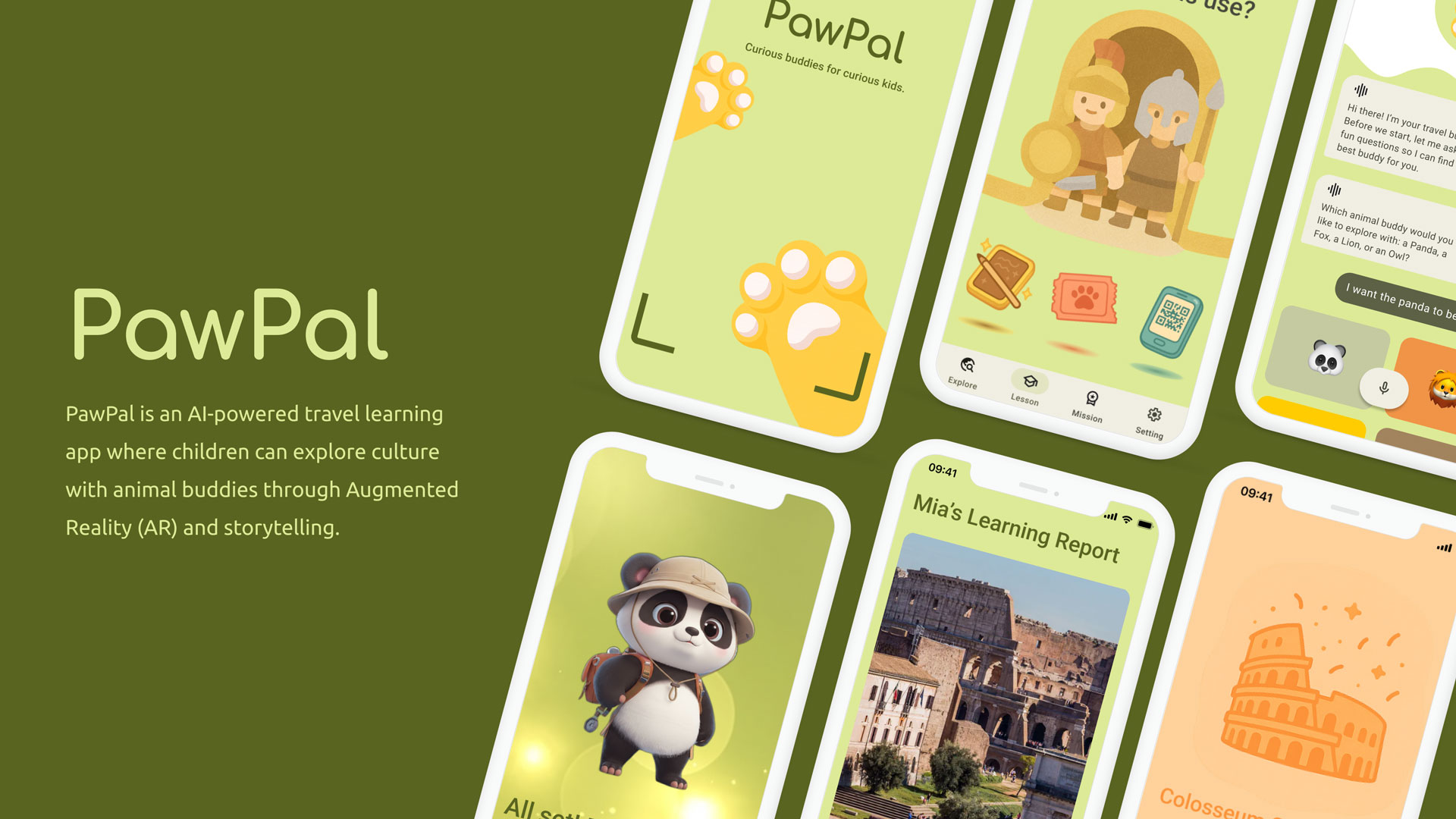
PawPal - AR Travel Learning App for Kids & Families
Travel can be a great way for children to learn about history and other cultures,...

Jiani Lin is a New York–based UX Designer who moved from industrial design into digital experiences through a passion for research and interaction design. With eight years in consulting, she’s led major UX initiatives, built scalable design systems, and created social-impact projects driven by human-centered thinking.
I’m a UX Designer based in New York, passionate about creating design that understands, involves, and endures.
I grew up in China and moved to New York in 2016 to study in the Products of Design program at the School of Visual Arts, where my fascination with design research and interaction design inspired me to transition from industrial design into the digital experience space.
Over the past eight years, I’ve worked in the consulting industry, leading UX initiatives for large-scale digital products and helping enterprise clients build sustainable design systems. Alongside this, I’ve also devoted time to projects that address social challenges—leveraging technology and human-centered design to create meaningful impact.
This blend of commercial and purpose-driven work has shaped my perspective as a designer and has been recognized through several international honors, including the MUSE Creative Awards.
I’ve admired this award program for years as a platform that celebrates meaningful design and innovation across industries. When I created the PawPal app, I felt it embodied the kind of creativity and purpose that MUSE stands for. The project reimagines how families explore the world together, blending storytelling, education, and emerging technology to make learning more engaging and accessible.
Winning this award means a great deal to me. It not only recognizes PawPal as a concept but also validates the curiosity, experimentation, and intent behind it. Professionally, it affirms my commitment to advancing design and technology in the consulting space. Personally, it reminds me that ideas rooted in heart and purpose can resonate globally.
I’ve always been passionate about using design to address social issues, and PawPal was born from that mindset. The idea emerged after reading research on how challenging it can be to keep children engaged during travel, especially at historical or cultural destinations. It reminded me of conversations with friends who are parents—they see the educational value in travel but often struggle to make those experiences meaningful for their kids.
Children are a unique and often overlooked user group in digital design. Creating something that is both educational and accessible—while also safeguarding their privacy and well-being—is a challenge, but it’s one I find deeply rewarding.
In today’s industry, I believe PawPal demonstrates how technology and empathy can intersect to make learning more inclusive, interactive, and human. It’s not innovation for its own sake—it’s about designing experiences that genuinely enrich people’s lives.
What sets PawPal apart is the intention behind every decision. As a UX designer, I constantly ask myself three questions: What problem am I solving? What does the user truly need? And is this the best solution for them? This mindset guided the entire process.
I also grounded my work in industry best practices—referencing design systems, accessibility standards, and interaction principles—to ensure the experience is not only innovative but also inclusive and intuitive. Every detail, from flow to interaction, was crafted with purpose, which I believe is what made PawPal stand out in such a competitive field.
PawPal was a unique challenge because it was designed for two very different audiences—kids and parents. Defining each group’s needs while creating a seamless experience that connects them was one of the biggest design obstacles.
To address this, I researched existing dual-audience apps to understand how others approached shared versus separate user journeys. From there, I mapped out both user flows to identify where their paths should diverge and where they should intersect to build a cohesive experience.
Throughout the process, I had to balance safety, privacy, and fun. The goal was to design a product that parents could trust and children would love to use. It was a complex challenge, but one that ultimately shaped PawPal into a meaningful, family-centered experience.
Winning is more than personal recognition—it’s an opportunity to bring greater attention to meaningful design and to often-overlooked user groups, such as children, in today’s digital landscape. I hope this achievement encourages more conversations about how design can empower younger audiences and create positive social impact through technology.
For me personally, this award has opened new doors for visibility and collaboration. I’ve already been contacted by journalists and had the chance to share PawPal’s story in the media, which has been both exciting and humbling. In the long run, I hope this recognition continues to amplify projects that combine creativity, empathy, and purpose in the UX field.
The feedback has been truly heartwarming. Friends who have kids told me they would love to use PawPal on their family trips to make travel more educational and engaging for their children. Hearing that the concept resonates with real parents—and that they can imagine themselves using it—has been one of the most rewarding parts of this journey.
My biggest advice is to truly enjoy the process and work on something you’re passionate about. When you care deeply about the problem you’re solving, that authenticity shows through every detail of your work.
Awards should never be the starting goal—they’re the result of curiosity, persistence, and a genuine love for what you create. Focus on the story you want to tell, the impact you want to make, and the people you’re designing for. When that passion is real, the work naturally becomes meaningful—and recognition will follow.
The creative industry is evolving faster than ever, and I believe the key is to stay adaptive—embracing new technologies while continuing to honor the fundamentals of UX design. Over the past two years, I’ve experienced firsthand how AI has transformed the design process, from ideation to rapid prototyping. I even integrated AI tools while designing PawPal, which allowed me to explore ideas more efficiently without compromising quality.
That said, technology should never replace the essence of good design: understanding users, researching their needs, and crafting experiences that truly serve them. As UX designers, it’s our responsibility to advocate for that balance and ensure technology enhances—not overshadows—the human experience.
Looking ahead, I hope to help define UX standards for how AI tools are used in the design industry, ensuring that innovation continues to respect usability, ethics, and accessibility.
Don’t let your experience—or the lack of it—limit your ideas. Every problem deserves to be solved, and every idea starts small: a note on a sticky pad, a sentence in your Notes app, a quick sketch in your notebook, or a simple grayscale wireframe in Figma. PawPal began the same way. The important thing is to get started.
Our influence as creatives is often bigger than we realize. Every campaign, product, or experience we design has the power to shape how people see, feel, and interact with the world. That influence is both a privilege and a responsibility—to use creativity not just to capture attention, but to inspire understanding, empathy, and positive change.
Although PawPal was an independent project, I’ve been shaped by the people and experiences around me. I’d like to dedicate this achievement to the mentors, friends, and families who’ve inspired me—especially the parents and children whose stories motivated this project.
Their curiosity and challenges remind me why human-centered design matters so deeply.
An accessible companion that reimagines family travel as meaningful, shared learning.
Right now, I’m continuing to work across two directions that I care deeply about—building large-scale digital platforms for global companies and creating social innovation projects that make technology more inclusive.
For both, my goal is the same: to design experiences that are more accessible, empathetic, and sustainable. I’m especially interested in exploring how emerging technologies like AI and AR can enhance learning, accessibility, and storytelling in ways that feel human and meaningful.
Looking ahead, I hope to keep bridging the gap between innovation and impact—using design not just to solve problems, but to inspire positive change in people’s everyday lives.