Cobble | French Design Awards
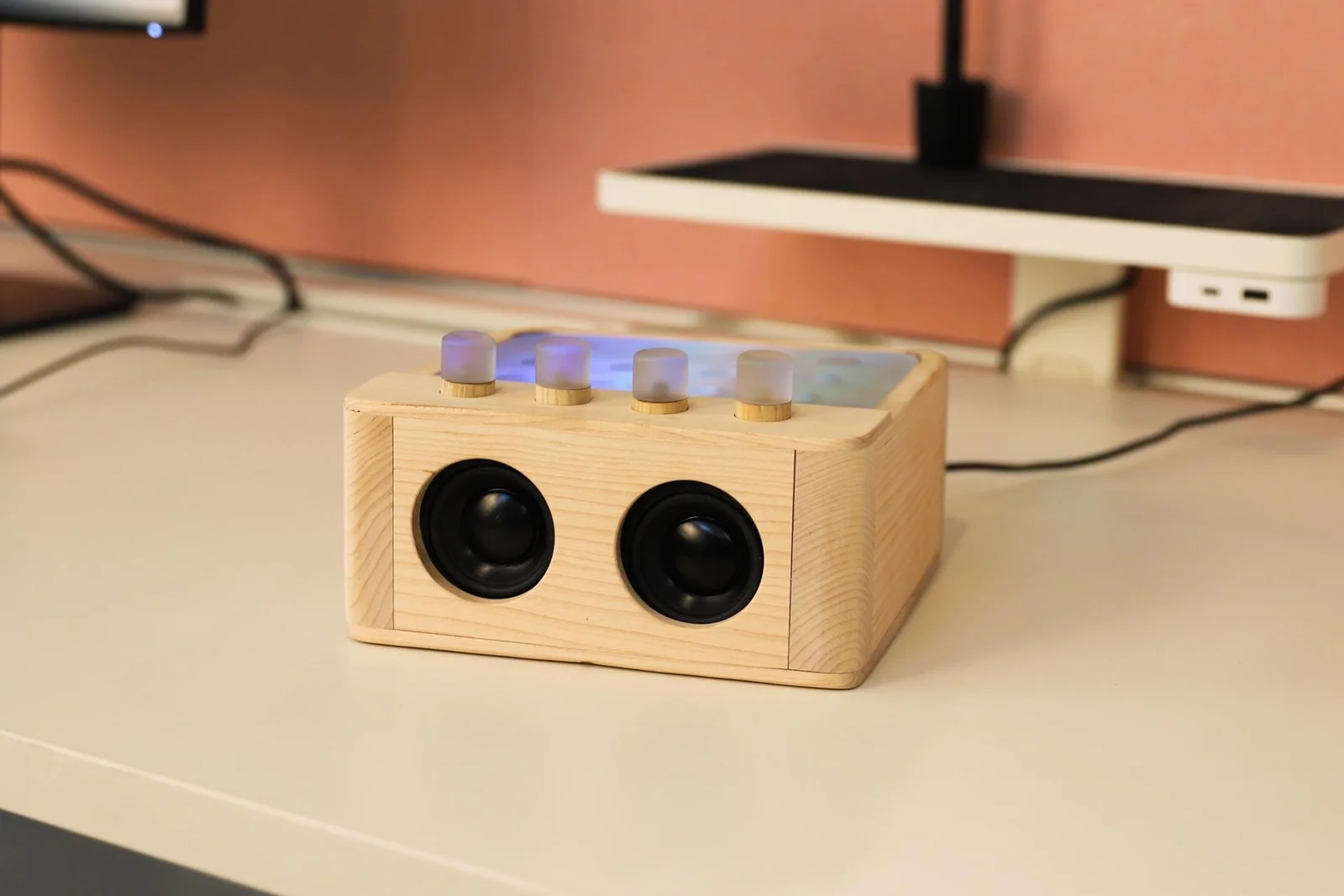
Cobble is an interactive speaker that expands the ways we play music. It features four...

I'm a product designer based in New York. I come from a background in industrial design at Rhode Island School of Design. I'm a multidisciplinary designer who enjoys bridging the gap between design, product, and engineering.
For me, design is about constructing narratives. Design thinking is about approaching and solving a problem creatively, and techniques and skills should not be the limitation of that. In my design journey, I’ve learned to build my design skill set based on what it takes to solve a problem that attracts me.
I realized that I was interested in lots of different subjects in high school, but I never felt confident that I could pick any of them as a lifetime career domain. I was also good at fine arts. It occurred to me that design would expose me to problem-solving experiences in various domains.
I also really enjoyed the process of constructing a systemic solution that’s tangible experience. It touched me that with a thoughtfully designed product, a user could simply feel good without knowing the amount of design expertise that went into the product.
I work as a product designer at Seek AI. Seek is a generative AI platform that empowers business users to query their datasets and frees up data teams from ad-hoc requests for analysis. As a sole designer, I am in charge of typical UI/UX design like maintaining the design system and creating mockups, but I also work on motion graphics, illustrations for blog articles, and other design jobs. I work closely with the engineering, marketing, and product teams to ensure that we deliver consistent narratives in the product.
On my own, I like to design outside the UI/UX realm. The winning entry Cobble is one such example. In my mind, there isn’t a fundamental difference between software and hardware design. The key is that they’re both solving problems.
To me, design means understanding the problem, listening to the user/stakeholder, coming up with a creative solution, and telling a good story while at it. I think what differentiates design from product management is that design is hyper-focused on what feels good above all, even though that might end up having to be compromised due to realistic constraints like timelines and resourcing. But as a designer, I make it my priority to always think about what’s the ideal design that I’d like to have.
My favorite kind of design is where the form complements the function. Coming from a traditional industrial design education, I’ve grown to appreciate when a design doesn’t feel extra when it comes to forms. Some of my favorite designs are pieces from Dieter Ram.
There are designs that I personally like and designs that are good. I acknowledge that I may not take a personal liking to a good design. To me, a good design is as simple as one that makes its target users fall in love with it. There is no set formula for a good design until it’s been tested by real users.
I was researching mindfulness and came to the conclusion that the mainstream focus on mindfulness overlooks how implicit the practice can be. So I wanted to create something that is functional and has mindfulness in it rather than focuses on mindfulness at the forefront. An office speaker felt like a great medium to afford a mindfulness interaction without being invasive.
I was inspired by the Chinese and Japanese board game Go. It strikes me as an interaction that’s not focused on mindfulness as a primary function but is extremely effective when it comes to leading players into the zone. I wanted to borrow some of that effect with the peg interaction on my speaker.
Definitely. I attended Go classes as a kid and that’s the main reason I was able to reflect on the specific board game when researching the topic.
I’m grateful that I received the award. It makes me feel recognized as an early-career designer and it really means a lot to me.
Cobble is a speaker that has a peg interface at the top. The user can arrange pegs in different patterns to activate sound profiles. I chose to enter this project as I personally love it. It’s something that I would purchase for myself if I came across it. It also felt really complete in the concept and I wanted to show it to the world.
The main challenge was in crafting the prototype. I worked with electronics and wood to create the prototype, but space was a main constraint. It was tricky to create a tactile interface that’s both spacious enough for the interior components and compact enough to fit the office workspace (feedback from my user testing group). I had to undergo a couple of iterations to find the right design and components.
It will keep me motivated and encourage me to try more original designs inspired from my personal memories.
There is always something new because the industry is forever changing. People’s backgrounds are extremely diverse, and they often bring vastly different but interesting perspectives and approaches to design. Designs are always controversial. I think it’s a good thing that there isn’t an objective solution for a design problem since it keeps the iterations alive.
I think my design is special in the sense that it has personal inspirations. The prototype is also finely crafted in a workshop by myself.
The design industry will definitely lean heavily into AI in the next decade. However, I don’t see that as being too different from when procedural design became popular. There will always be new tools to use and designers will just learn the new way to gauge user needs.
Just keep at it and give it your best. The best design is one that you’re proud of creating before anything else.
Design critiques are extremely important. Technical skills can be learned on your own but without feedback from others, it’s hard to improve your design thinking and broaden your mindset. If you have the resources, attend design classes, find professionals, and get critiques.
I didn’t like most of the hobbies I had as a kid. It’s only after I grew up that I started to appreciate lots of things.
Honestly, I don’t have one great person. My life is an amalgamation of influences and it’s hard to pinpoint one that had the spark. I would say the original iPhone 4 (Steve Jobs & Jony Ive) left a deep impression on the younger me when it comes to my interest in design, but this is more about a specific product versus specific persons.
Never get stressed out over things you can’t control. What happened has happened and the best thing to do would be to keep your head up for the next day.
Read about the interview: Yinzhu Yao Shares How She Unites Cultures Through Creativity here.