The Path Divider
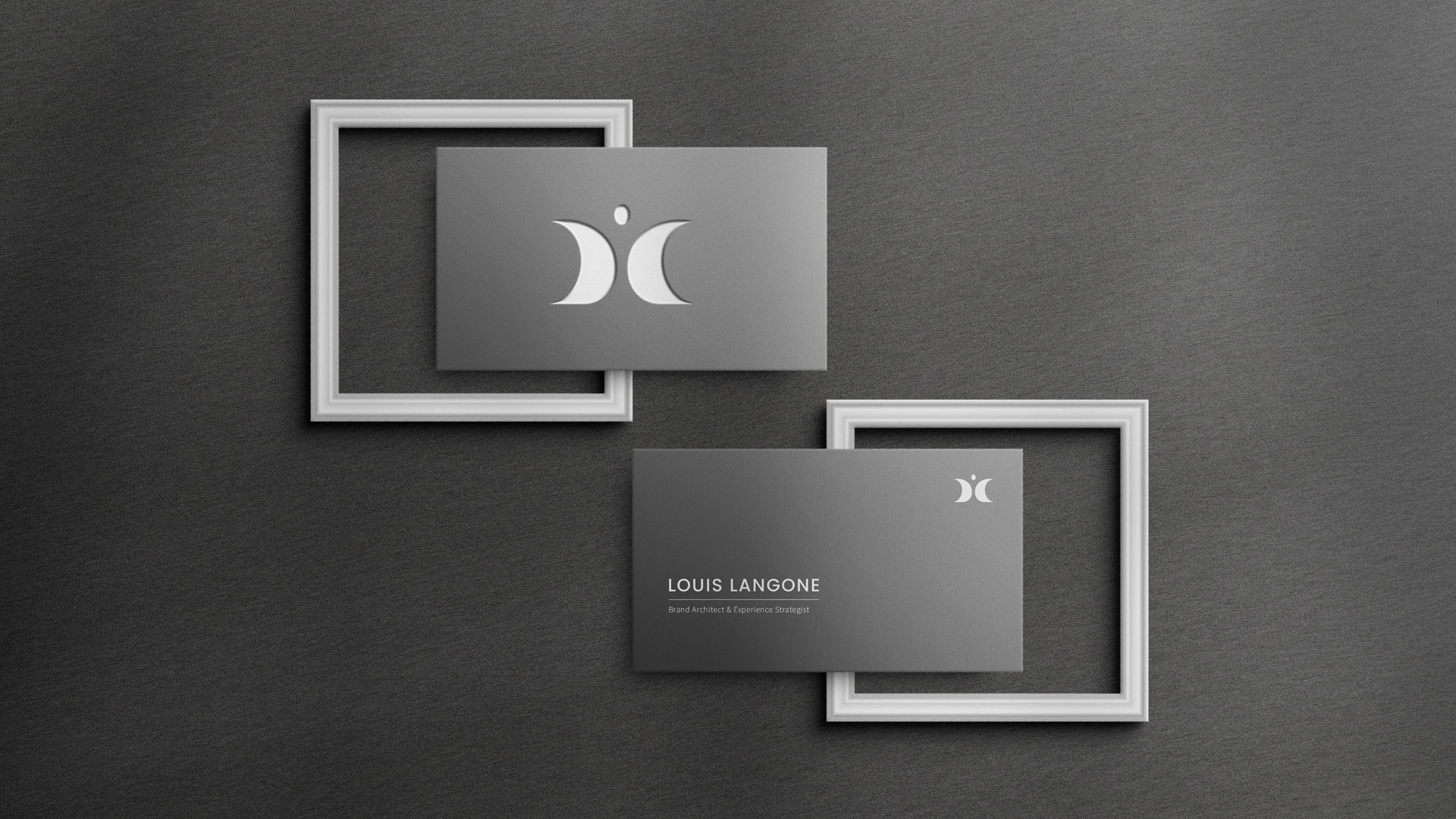
“The Path Divider” is the core logo of the personal corporate identity developed for Louis...
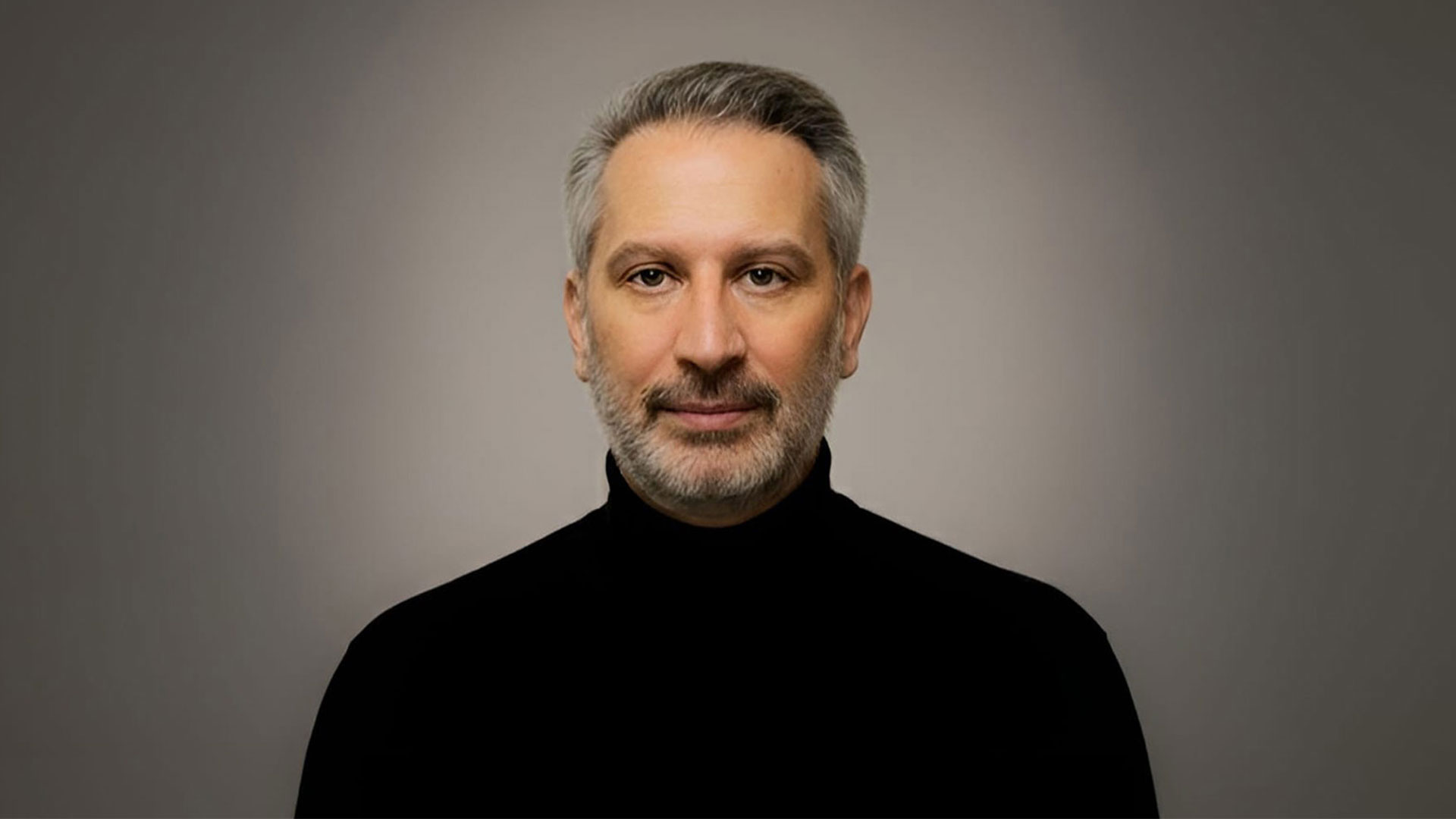
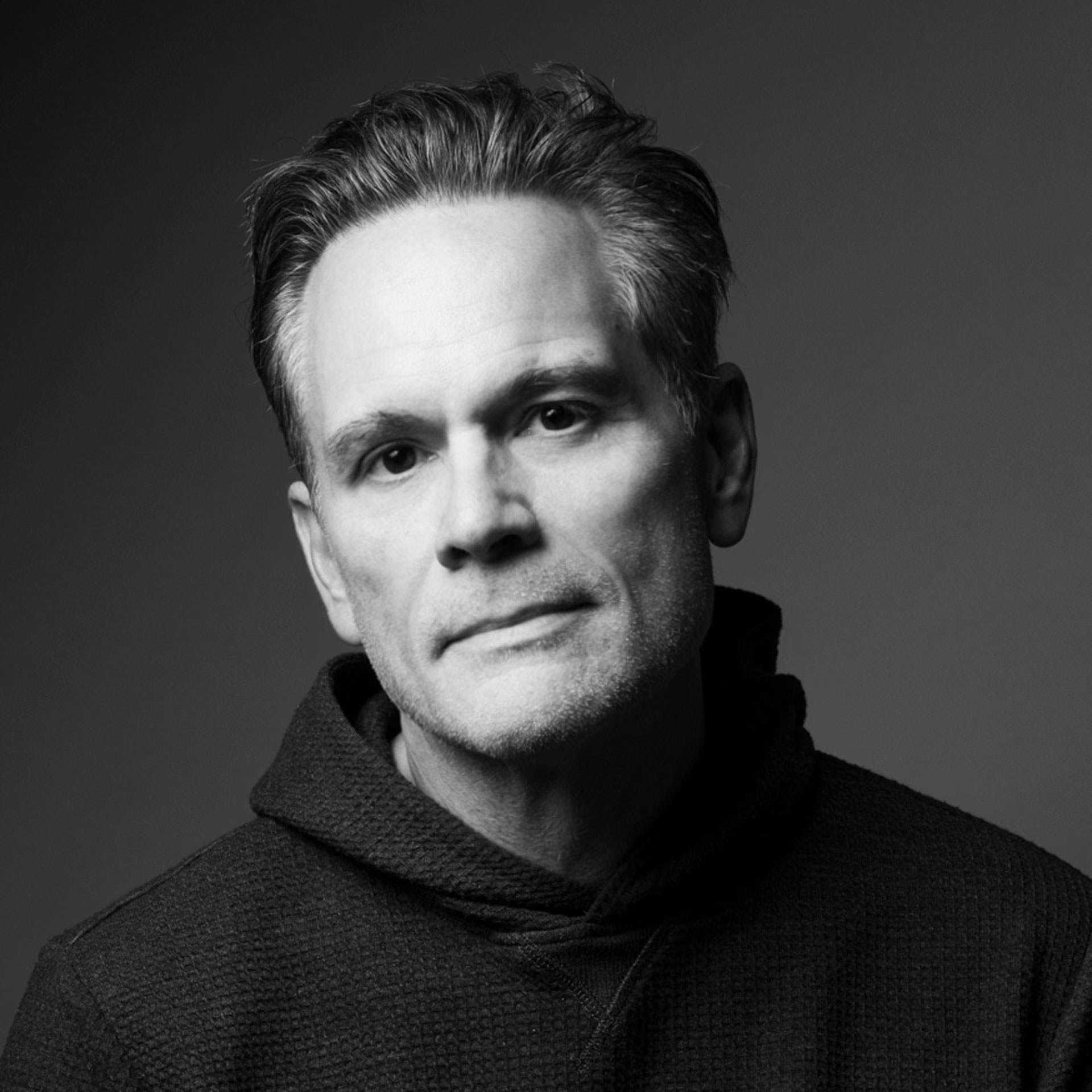
Louis Langone is an Italian Brand Architect and Experience Strategist with over twenty years of practice, known for the Langone Framework, which designs brands as cultural systems rather than simple visuals.
My name is Louis Langone, and I am an Italian Brand Architect and Experience Strategist. My journey into this field began in a seemingly distant area from creativity: technical marine engineering, which I studied at the historic Nautical Institute “Cristoforo Colombo” in Camogli, Italy. That education gave me a rigorous mindset — a focus on systems, logic, details, and the real-world consequences of design decisions.
For more than twenty years, I have worked within hospitality, entertainment, and experiential marketing ecosystems, focusing on brand identities, narrative systems, and experience architectures. Over time, I developed the Langone Framework, a cognitive model I use to design brands as cultural structures: not just logos, but meaning systems that shape perception and guide behavior.
I decided to enter the LIT Advertising Awards to test my work in an international and highly competitive context, outside of my usual Italian comfort zone. I wanted to understand whether an approach grounded in semiotics, psychology, and cultural structure could also be recognized within an award program focused on identity and communication.
Winning, for me, means two things: on a personal level, it confirms that following a non-conventional path is worthwhile; on a professional level, it serves as meaningful external validation of my design methodology, which connects strategy, design, and human behavior.
“The Path Divider” was born from a very specific image: two opposing waves separated by a human figure in the center. The waves represent the chaotic flow of stimuli, information, and possibilities that define today’s creative industry; the central figure, drawn in negative space, is the Brand Architect who “parts the waters” and makes a direction visible.
This archetype — an almost implicit reference to Moses opening the sea to reveal the way forward — becomes an identity system. The central ellipse is both the head of the Brand Architect, the point from which ideas originate, and the path that opens through the chaos, bringing order and orientation.
In a context where many brands try to gain attention by adding more noise, “The Path Divider” aims to express the opposite: the ability to create clarity, make decisions, and guide people toward a meaningful path instead of letting them be overwhelmed by the waves.
I believe “The Path Divider” stands out for the way it holds together three levels: conceptual, symbolic, and systemic.
First, there is a clear idea at its core: in a sea of possibilities and noise, the Brand Architect is the figure who “parts the waters” and makes a path visible. This image becomes a simple symbol — two waves and a human figure in negative space, with an ellipse that serves simultaneously as head, road, and orientation — yet it carries a strong layer of meaning.
Second, I did not design just a logo, but an identity system: grids, proportions, and consistent applications that allow the mark to function across many touchpoints while always conveying the same message of clarity and direction.
Finally, I think the project shines for its balance between rigor and accessibility. It is deeply conceptual, but it does not require the audience to understand the theory for it to be effective. Even without knowing the story behind it, viewers can perceive a sense of movement, divided masses, and a clear path at the center. This dual reading — immediate, yet profound for those who seek it — is likely what made the project stand out in such a competitive field.
The main challenge was translating an extremely abstract idea — the moment when a choice divides possible paths and brings order into chaos — into a graphic mark that is simple, legible, and memorable.
There was a double risk: on one hand, creating something too conceptual, understandable only with heavy explanation; on the other, falling into empty minimalism, visually pleasant but disconnected from the project’s deeper meaning. I resolved this tension through iteration and subtraction, exploring variations of the waves, the central figure, and the ellipse, discarding anything that did not genuinely add meaning.
I tested the mark on two levels: a rational one (its consistency with the archetype of the Brand Architect who “parts the waters” and opens the way) and a perceptual one (impact, mass balance, and recognizability at different scales). Only when form and meaning began to work together — without one overpowering the other — did I know I had overcome the obstacle and found the definitive version of “The Path Divider.”
I hope this achievement will open new conversations with CEOs, founders, brand leaders, and creative directors who are not simply looking for “a logo,” but for a partner capable of building identities as coherent systems — where idea, structure, and design align.
For my career, this award is an important confirmation: it shows that my way of working — grounded in strategy, semiotics, psychology, and experience architecture — can be recognized in an international context by juries who evaluate many high-level projects. Over time, I hope it serves as a signal of reliability for those who want to address complex challenges in brand architecture, experience strategy, and narrative systems, rather than just tactical communication activities.
For me, “The Path Divider” is not only a winning mark, but a demonstration of my ability to maintain strong coherence between the initial idea and the final design — from conceptual archetype to visual form, without losing depth along the way.
Even though the award is recent, I am already seeing its impact: increased interest in my work, deeper conversations with professionals and decision-makers, and new collaboration opportunities that likely would not have emerged without this recognition.
The reaction has been very warm and, in some cases, surprisingly emotional.
Clients, collaborators, and long-term stakeholders saw this award as an external confirmation of something they had already perceived over the years: that behind the logos and visual systems, there is always a solid conceptual and strategic foundation.
One of the most frequent comments was:
“You can tell this mark is not just aesthetics, but the result of deep thinking.”
What moved me most was receiving messages not only from people in branding and marketing, but also from those who work “on the ground” — managers, operational leaders, and entertainment professionals — saying they saw themselves in the idea of “opening a path” through everyday chaos.
Perhaps the most meaningful moment was realizing that “The Path Divider” created connections beyond the project itself: it became a way for some people to describe my role, not just a winning logo.
My first advice is not to begin with the goal of “winning an award” or proving your drawing skills, but with the goal of truly achieving the outcome the project is meant to create. A piece becomes “award-worthy” when it is deeply aligned with its purpose, long before it is visually impressive.
For me, three things are essential:
- Start from meaning and the final objective: understand what change you want to create for the brand and for people, and judge every decision against that.
- Work with clear constraints: context, limits, and real audiences keep the project anchored to reality rather than creative ego.
- Remove everything that is merely decorative: if a solution looks beautiful but does not move you closer to the objective, it should go.
As a mindset, I would say: clarity of purpose, discipline, and respect for the people who will live the project. Graphic skills matter, but it is the coherence between idea, function, and form that truly makes a piece of work award-worthy.
I see the evolution of the creative industry as a huge expansion in tools and speed, but not always in meaning. AI, automation, and digital platforms have made it easier to produce content, but they have also increased noise and fragmentation.
For me, the real challenge is not to “do more,” but to design better what truly matters: identities, meaning systems, and experiences that stay in people’s minds. I believe that in the future, value will not lie in the ability to generate output, but in the ability to create coherence between what a brand says, does, and makes people feel.
Over time, I hope to position myself more and more as a Brand Architect and Experience Strategist working alongside CEOs, founders, and creative teams — someone who uses tools like the Langone Framework to build clear cultural structures where idea, language, and design move in the same direction.
In an industry that is constantly accelerating, my goal is not to be the one who produces the most content, but the one who helps brands find and maintain a recognizable direction, even as everything around them continues to change.
Entering awards can feel intimidating, especially at the beginning, but I would start with one question: who is actually measuring your work?
We often hear “this is nice,” “well done,” or “this works” from clients, colleagues, or friends. That feedback is useful, but it also comes from a protected context. Submitting a project to international juries — with different cultures, expectations, and standards — gives you a much clearer sense of how your work holds up outside your own bubble.
This is why I believe awards help you position yourself mentally: they show you not only whether your work is effective, but how it performs in a context larger than you, your city, or your local market. Testing yourself beyond a friendly client’s pat on the shoulder has enormous value for both personal and professional growth.
To anyone hesitating, I would say: don’t view it as a final judgment, but as a way to raise your own bar. Every submission is an act of courage and clarity — it forces you to look at your work honestly and to get used to presenting your ideas on a bigger stage.
The message I would like to share is this: never underestimate the impact we have on people’s minds.
Every headline, every visual, and every identity we put into the world is not just “content” — it is a piece of language that shapes how people think, desire, and remember. We are not only designing campaigns; we are designing mental frames.
In a landscape where it’s easy to chase algorithms, trends, and whatever “performs” in the short term, I believe our real responsibility as a creative community is to ask ourselves what kind of culture we are feeding. Are we adding meaning, or simply adding noise?
This is not about being heavy or overly serious; it’s about being more conscious. We can make people laugh, surprise them, entertain them — and still respect their intelligence by giving them something that stays with them after the click.
If there is one thing this award has reminded me of, it’s that when idea and form are truly aligned, the work doesn’t just speak about us as creators; it speaks to and for the people who experience it. And to me, that is the most meaningful measure of what we do.
I would like to dedicate this achievement to two groups of people.
The first group is made up of all those who, over the years, had the courage to trust a non-conventional approach: CEOs, founders, directors, and entrepreneurs who didn’t just ask for “a logo,” but for a vision — and who gave me the space to build identities, experiences, and meaning systems. Without their trust, “The Path Divider” would have remained an idea in my sketchbook.
The second group is the teams I’ve worked with on the ground — in entertainment, hospitality, and events — who have transformed abstract concepts into real experiences for people. They are the ones who “part the waters” every day in practice, navigating complexity, chaos, and unexpected challenges while still delivering something coherent with the original idea.
For me, this award is proof that when strategic vision and teamwork meet, the result can resonate with both an international jury and the real lives of the people who experience it.
The Path Divider is an identity system that transforms the image of a Brand Architect parting the waters into an essential mark that brings order to chaos, capturing — in a simple and memorable way — the exact moment when a decision opens a clear path.
In the next few years, I want to keep moving in two parallel directions: practice and research.
On one side, I am focused on applying the Langone Framework to increasingly complex projects in brand architecture, identity systems, and experience strategy — working alongside CEOs, founders, and creative teams who want to transform their values into clear cultural structures, not just short-term campaigns.
On the other side, I’m beginning to shape a more explicit educational track: content, workshops, and learning experiences for people who want to design brands not only as images, but as meaning systems that shape perception and behavior.
In short, what’s next for me is continuing to build projects that live in the real world — not only in presentations — while also sharing the methodology behind them, so more people can use it to create more conscious identities and experiences.