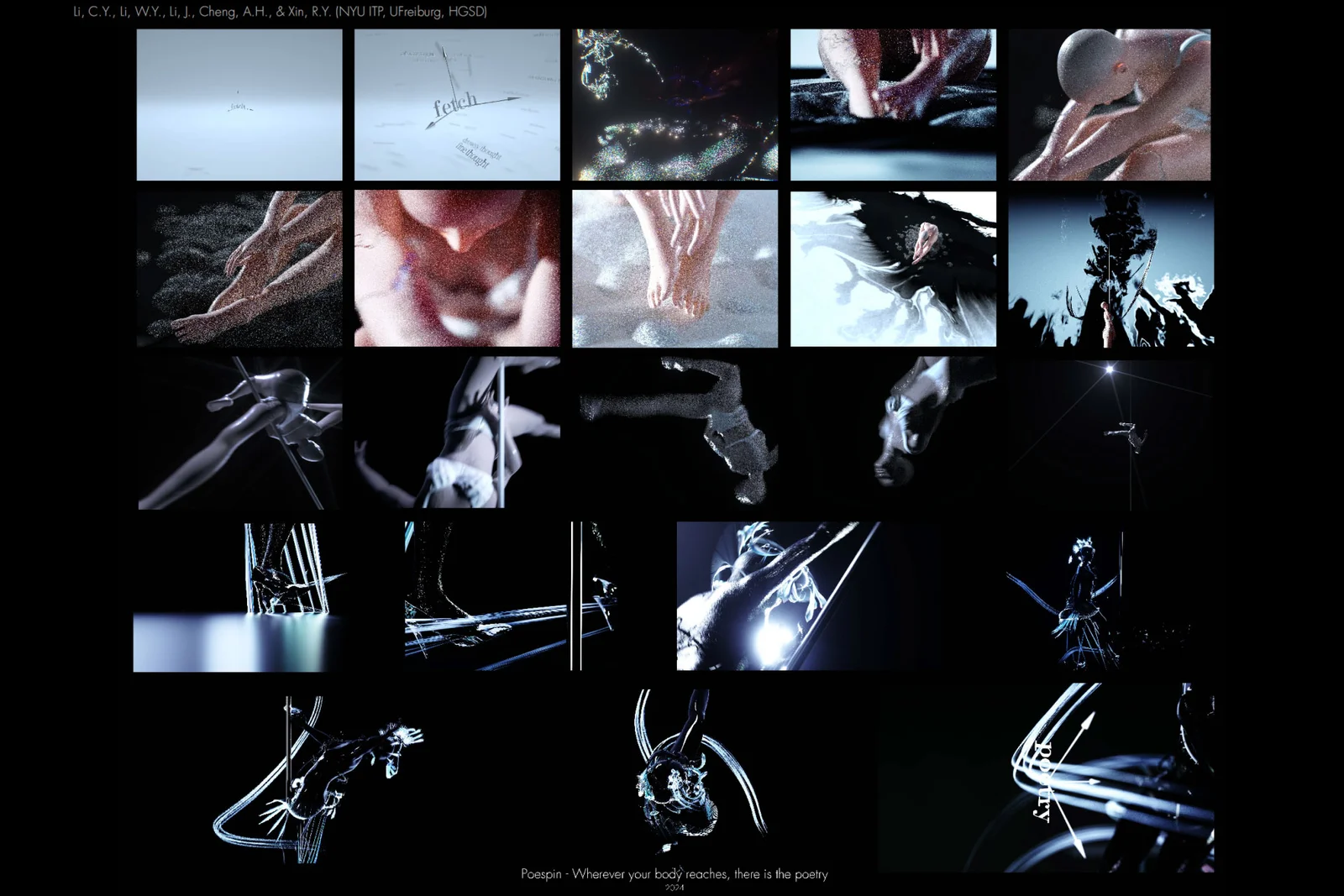
Poespin-Wherever your body reach, there is a poetry | 2024
PoeSpin-Wherever your body reaches, there is poetry’ is a human-AI co-creating system, an electronic ritual...
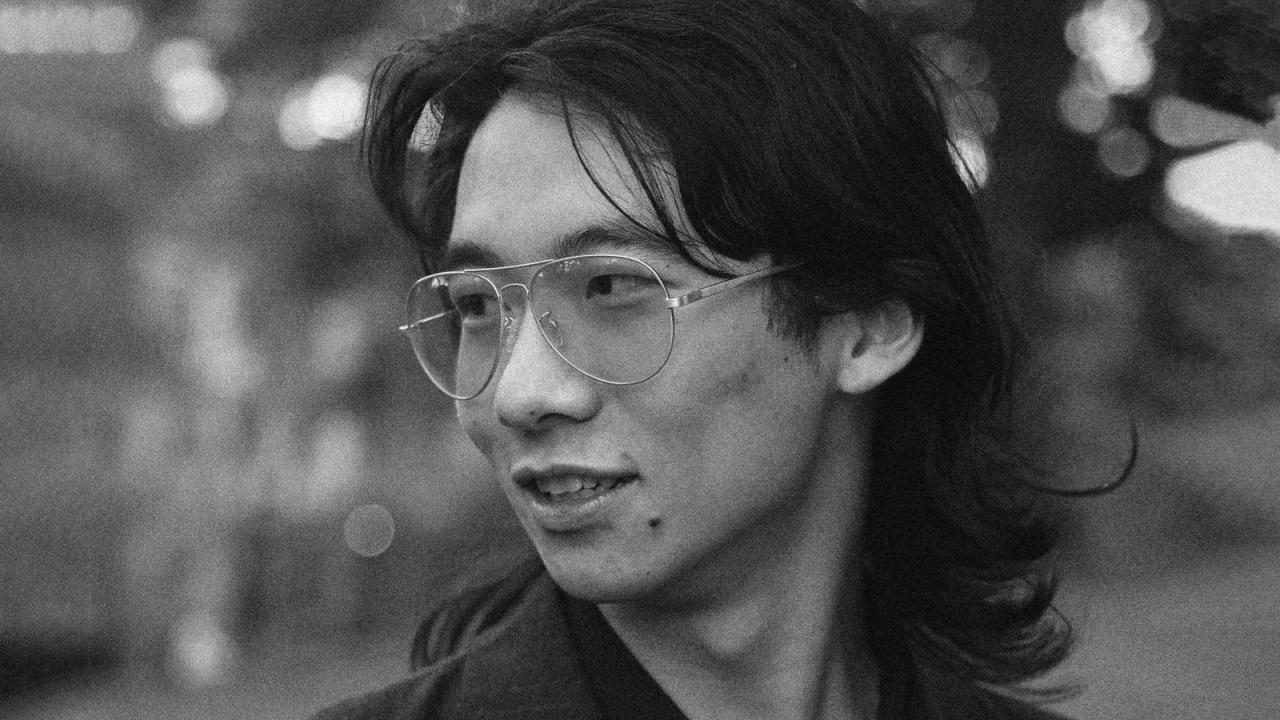
I'm Cory (Yihua Li), a Chinese-American artist based in Brooklyn, New York. As a media artist, VTubing enthusiast, illustrator, and CGI specialist, my work takes many forms: games, products, films, and CGI.
I'm not an artist with a specific visual style, but rather focus on narrative and the emerging content behind technology itself. I love to perceive media as a metaphor for human perspective and agency in facing this world.
I identify more as an artist because, while design may have many rules and methodologies, no one dares to define what art is. I enjoy organizing my understanding of the world and people through art.
This project began as a final assignment for my course at New York University, but I saw great potential in it and spent about four months refining and developing it into a larger project. Wendy, a pole dancer, helped solve the motion capture aspects for pole dancing. As I gradually improved the code and initial CG concept, we reached out to Reraner Yetong Xin from Harvard CAM Lab/Refik's studio to join us. I collaborated with her on the dance CG portion.
The entire process was truly remarkable. I never imagined this project could become a reality or that I’d have the opportunity to collaborate with such talented individuals. It's been an amazing journey—from a university assignment to a fully realized project with multiple collaborators.
Design, to me, means gaining insight into the needs of the design subject, logically integrating those insights, and creating a narrative. For our project, design involves understanding the background and characteristics of pole dancing as a dance form, the dancer's choreographic ideas and challenges, and creating an appropriate context to address or solve these issues.
In terms of results, I prefer designs that are clear and simple, yet offer infinite possibilities when people interact with them. This type of design is more like a social experiment than a definitive solution. It can highlight certain issues non-verbally and provoke thought, perhaps in the realm of speculative design or design futures.
In terms of process, I hope the design carries a strong humanistic touch. It should take into account the feelings of all stakeholders, based on a thorough understanding of the problem.
I believe the most important thing is that the design makes sense. The designer should also be aware of where the focus of the design lies. Don’t try to do everything—stick to a core creative concept. Personally, I prefer works that showcase out-of-the-box thinking but can still justify themselves
I've been thinking about this myself and have discussed the issue of style with some artist friends. The consensus is that we all believe style can't be deliberately pursued. For us, as novice designers and artists, it might be too early to establish a style. On the other hand, it's quite contradictory that the media-driven landscape we live in requires artists to have a relatively fixed 'personal style'; otherwise, they risk not being remembered by the public.
I personally have some aversion to fixed visual styles because they conflict with my design philosophy. I care more about content, narrative, and concept. However, if we're talking about what I've consistently focused on in my creative journey, it's my desire to understand as comprehensively as possible the individuals I'm serving and their environment, and to amplify the potential for positive growth.
I aim to adhere to visual Gestalt principles and want my solutions to be unique, bold, and playful enough to explore various possibilities.
My design process is a bit unusual. After being handed a task or even a problem, I break each part down into concepts. It's a bit like making a collage or building with blocks.
I carefully examine what technology I'm currently working with can do and what possibilities it brings, then combine it with concepts from cultural, philosophical, and social levels. Once a relatively clear vision is formed, the workflow usually emerges naturally.
Absolutely, or rather, I'm increasingly appreciating this aspect. For example, the design of the "Chain Poetry" is a response to my culture as a Chinese designer. I believe that literature and history are not useless disciplines because they all contain logic and design.
As an Eastern designer, I might not be particularly obsessed with the problem itself, but rather with the overall feeling and impression my service object gives me. It's like writing a story, continuing a beautiful possibility for them. In this process, problems are automatically addressed rather than deliberately solved.
We are currently working on V2, the immersive exhibition part of it. The encouragement from MUSE gives us more confidence and desire to bring this poetic experience to a wider audience. It's very honorable and meaningful to be able to document the world's first pole dance poetry project through this platform and award.
We also hope to prove that AI art has more possibilities beyond prompt engineering. These lens can showcase the cognition of the virtual world of computers. More people should understand its appearance and charm.
PoeSpin is a human-AI co-creating writing system that transforms pole dancing movements into poetry, blending Eastern and Western artistic traditions. Our project employs three innovative approaches: first, AI-driven poetry composition inspired by dance, incorporating the circular Chinese "Lianhuanshi" (连环诗) form, or "Chinese ring poetry," to reflect the rotational nature of pole dancing.
Second, reducing the dimensions of word vectors to create space for dancers to experiment with 'automatic writing.' Lastly, expanding the dimensions of captured body movement to explore semantic meanings.
By fusing W. B. Yeats' poetry with Chinese poetic structures, PoeSpin creates a unique narrative that bridges cultures. It reimagines dance as a universal expression, projecting it into verses that embody both physical grace and cultural heritage. This is also the first 'dance-to-poetry' art project to interpret pole dancing through a computational linguistic perspective.
Visualization of Word Vector space and mapping the dancer's movement into this space.
Winning in the MUSE Design Awards has been a significant milestone for our team. It has boosted our confidence in the PoeSpin project and motivated us to continue developing its potential.
This recognition has opened up new opportunities for collaboration and exposure, allowing us to share our innovative approach to AI art and poetry with a wider audience. It has also validated our efforts in bridging Eastern and Western artistic traditions, encouraging us to further explore the intersection of technology, dance, and literature in our future works.
The constant evolution of technology and its integration with art, allowing us to explore new forms of expression and push the boundaries of creativity.
The ability to bridge different cultures and traditions through design, creating unique narratives that resonate across diverse audiences.
The open-ended nature of art and design, which allows for endless exploration and interpretation, encouraging us to continually challenge our perspectives and methodologies.
The United States, specifically, New York City holds a unique position in the design industry for several reasons:
Cultural melting pot: The city's diverse population brings together influences from around the world, fostering a rich tapestry of ideas and aesthetics that fuel innovative design.
Intersection of industries: New York is a hub for fashion, art, finance, and technology, creating a dynamic environment where design intersects with various fields, leading to cross-pollination of ideas and multidisciplinary approaches.
Competitive spirit: The fast-paced, high-energy atmosphere of New York pushes designers to constantly evolve and stay at the cutting edge of their craft, resulting in trend-setting and forward-thinking design solutions.
I think perhaps technological issues won't be a major obstacle. More designers will expect or form more independent ways of survival. The virtual world will be able to have its own social order and efficiency to operate and influence work in the physical world.
Try to complete the project and provide thorough documentation to help the judges quickly identify its value.
Go see more great works and try to understand their composition. Twitter is actually a very good starting point. You can follow the artists you like, learn about their work, and see how they create.
We hope to one day collaborate with FKA Twigs and Andrew Thomas Huang on this project. Our work is partially inspired by 'Cellophane.'
My mentor, Allison Parrish, has inspired me greatly. She's an expert in computational linguistics with an astounding knowledge base and deep insights into the field.
Another significant influence is Yuqian Sun (Cheesetalk), a senior figure who introduced me to the creative industry. I learned a lot while working as her artist assistant. Our project was also influenced, to some extent, by her Red Dot Award-winning work, AI Nüshu. We hope to address social injustices through creativity and art.
The key might be persistence. Looking back at my achievements over the past six months, I'm quite shocked. The process was painful because I had to handle most of the development and production work myself, but it was worth it.
I've always believed that some inspirations might be God's whispers to me, and I'm just a medium bringing them into this world. It's best to follow your natural creative impulses and bring them to life.
I would like to extend special thanks to Wendy for firmly choosing and supporting my ideas at that time. I'm also grateful to Archy Hongyue Cheng from Germany, who willingly discussed concepts with me and provided very insightful poetry readings. Additionally, thanks to Reraner and Yufan Xie for their assistance with the CG.
Read more about this interview with Ronnie Lin, the Founder and Designer of AI Smart Space System, the Gold Winner of the 2024 MUSE Design Awards.