
Design & Inspiration
Weiran Yin Explores How Landscapes Can Hold Memory Through The Dissolved Monument
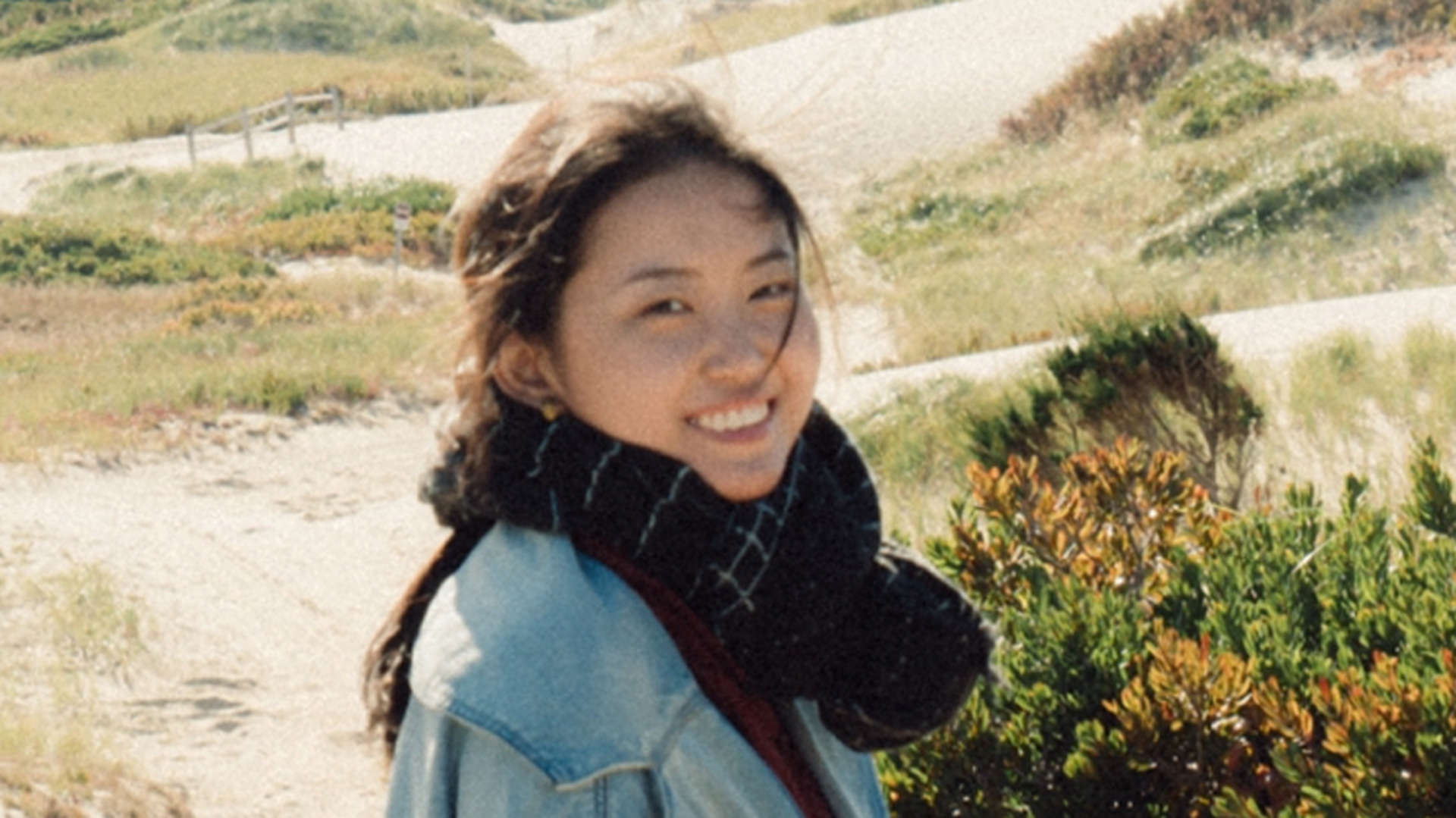
Weiran Yin
Weiran Yin is a landscape designer practicing in the United States whose work weaves together community culture, collective memory, and ecological systems to create public spaces that nurture belonging.
I am Weiran Yin, a landscape designer currently practicing in the United States. My work focuses on exploring how community culture, collective memory, and natural systems can be meaningfully integrated to create public spaces that foster a sense of belonging and strengthen social connections.
I received my Master of Landscape Architecture degree from the Harvard Graduate School of Design, and I am currently engaged in community-oriented public landscape projects in Florida, where I continue to explore how landscape design can support both ecological resilience and shared civic experience.
My path toward design grew from a long-standing interest in cultural diversity and a genuine curiosity about people and their everyday experiences. Since childhood, I have pursued creative activities such as writing, drawing, and model-making, and landscape architecture felt like a natural convergence of these interests.
What continues to inspire me about the profession is its ability to merge creativity with technical knowledge to shape environments that contribute to community well-being and shared human experience.
Being recognized by the MUSE Design Awards at this stage of my career is deeply encouraging. It affirms that the design values I care about—integrating culture, memory, and landscape—can resonate with a broader audience. The award also provides a meaningful platform through which my design approach and ideas can gain wider visibility and engagement.
This recognition gives me greater confidence to continue developing my practice and exploring how landscape design can contribute to community life and enrich shared public experiences.
This achievement marks an important milestone in my early professional career. It has increased the visibility of my work and strengthened my commitment to pursuing design approaches that integrate cultural narratives with landscape systems.
The recognition has created opportunities to present my work to a wider audience and connect with professionals across different disciplines and regions. It also encourages me to continue expanding my practice and exploring new possibilities for collaboration and research through design.
Experimentation plays a crucial role in my creative process, allowing me to bridge conceptual thinking with real environmental conditions. Through analytical exploration, I test assumptions and study site-specific dynamics to ensure that design proposals respond meaningfully to natural systems.
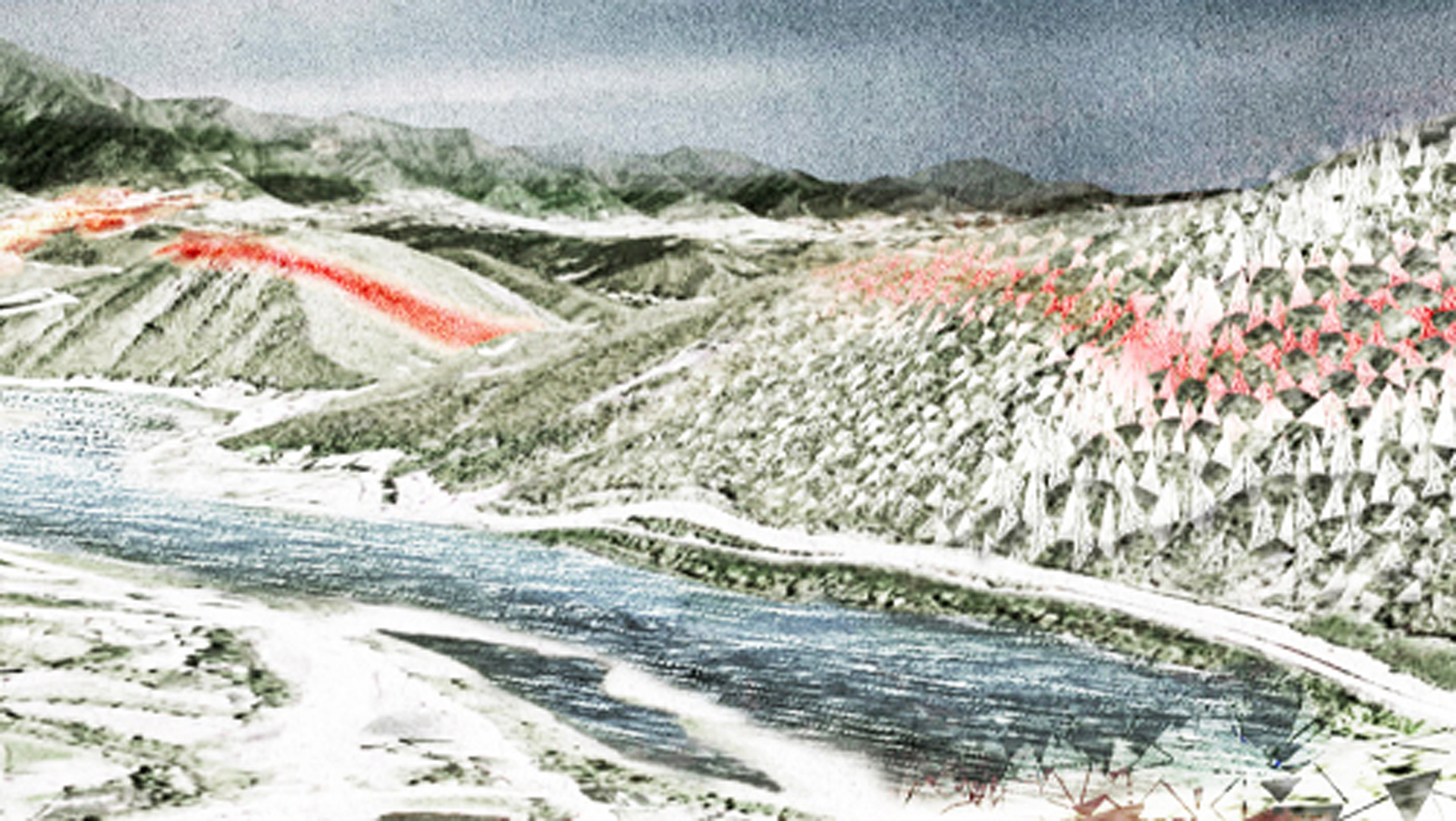
For example, in my award-winning project The Dissolved Monument: Restoring Land Through Remembrance, I utilized ArcGIS analysis together with the RUSLE erosion model to simulate patterns of non-point source pollution across the landscape. This process informed the placement and spatial extent of the installation system, grounding the design in ecological performance.
At the same time, experimentation for me is not purely analytical. Inspiration often emerges through intuitive and sometimes unpredictable processes. I frequently work with simple materials such as paper strips or wire to freely explore forms, and the spontaneity found in these physical studies often leads to more refined and intentional design outcomes.
One of the most unusual sources of inspiration for me came from observing the internal structure of a pomegranate. While eating the fruit, I noticed the small, regularly arranged cavities left behind after the seeds were removed. The repetitive yet organic pattern revealed a subtle spatial order shaped by natural growth.
This observation inspired me to explore a land art installation composed of repeated modular elements arranged across the landscape. It reminded me that design inspiration can often emerge from everyday moments, where natural structures reveal unexpected spatial logic and rhythm.
One thing I wish more people understood about the design process is that meaningful design often emerges from a dialogue between the built environment and natural systems, rather than from isolated symbolic gestures.
In my project The Dissolved Monument: Restoring Land Through Remembrance, I questioned the traditional approach to historical monuments, which often rely on strong symbolism and singular forms. I believe commemorative landscapes should tell stories while remaining integrated with their surrounding ecological context. This idea became the starting point for designing a narrative-driven ecological purification installation that allows memory and landscape to evolve together over time.
As an early-career designer, I am still learning how design ideas evolve through collaboration. From my experience working within project teams, I have come to understand that balancing design intentions with project requirements is less about compromise and more about communication.
Clients often bring valuable insights related to use, context, and long-term needs, while designers contribute spatial thinking and conceptual direction. My approach is to identify shared goals and translate them into solutions that remain faithful to the core design intention while responding realistically to project conditions.
In many cases, constraints do not limit creativity; instead, they help clarify and ultimately strengthen the design outcome.
One of the main challenges in developing this project was finding a way to convey narrative through an ecological installation, allowing the monument to merge with the natural landscape rather than exist as a separate object. Traditional monuments often rely on strong visual representation, while this project sought to embed commemorative meaning within the landscape itself.
To address this challenge, I conducted extensive research into historical materials and identified a broader spatial narrative based on the historical routes of movement across the site. At the same time, I studied local materials and environmental characteristics, which led to the development of a color-coded system that translates historical memory into a landscape intervention integrated with ecological processes.
When I experience a creative block, I usually return to research and observation. Reading historical and cultural materials related to a site helps me reconnect with the deeper narratives behind a project and often reveals new design possibilities.
I also seek inspiration outside of landscape architecture by engaging with other art forms such as painting, sculpture, and spatial installations. Encountering different artistic languages allows me to reset my thinking and approach design from new perspectives.
In addition, conversations with friends and peers often help me gain fresh viewpoints. Discussing ideas in a relaxed setting not only introduces unexpected perspectives but also helps me step away from pressure and restore a clearer, more open creative mindset.
My designs are deeply influenced by my interest in cultural memory, human experience, and the relationship between people and the environments they inhabit. I am particularly interested in how landscapes can carry stories over time and create a sense of belonging within communities.
Personal experiences observing different cultural contexts and everyday environments have shaped the way I approach design. I tend to pay close attention to subtle spatial qualities found in nature and daily life, often translating these observations into narrative-driven landscape strategies.
For me, design is not only about creating physical space, but also about fostering emotional connections between people, history, and the natural environment.
One piece of advice I would offer aspiring designers is to stay curious and allow themselves time to explore. Design is rarely a linear process, and moments of uncertainty or difficulty are often where meaningful ideas begin to emerge.
I encourage young designers to look beyond their own discipline, observe everyday life closely, and gradually develop their own way of thinking rather than trying to follow established formulas for success. In the long run, cultivating an authentic perspective is more important than achieving quick results.
If I could collaborate with any designer, I would choose Kongjian Yu. His work has profoundly reshaped my understanding of landscape—not merely as a formal composition, but as a medium that carries ecological processes and cultural meaning.
I strongly resonate with his efforts to move contemporary Chinese urban landscapes beyond excessive hardscaping and formalism toward systems that are ecologically resilient and culturally grounded. His approach demonstrates how landscape architecture can operate as both environmental infrastructure and socially meaningful public space.
If I could ask one question about my own work, my question would be: “How can landscape design shape the way we remember and experience time?”
I would say that landscape is not static—it evolves through seasons, ecological processes, and human interaction. Through design, I hope to create environments where memory is not represented by a single object, but embedded within living systems that grow and transform.
For me, the most meaningful landscapes are those that allow culture, ecology, and collective experience to coexist and continue unfolding over time.
Winning Entry
Explore the journey of Yitian Zeng and Shinga Yoshimine, the Silver Winners of the 2025 MUSE Design Awards. They are designers united by a shared commitment to human-centered solutions, transforming everyday observations into thoughtful design through their project EcoEat.
ADVERTISEMENT

Latest Posts
MUSE Creative Awards & MUSE Design Awards Reveal 2026 Season 2 Winn...
OCTOBER 16, 2026
2026 Noble Technology Awards Announces Season 2 Winners Advancing t...
OCTOBER 16, 2026

2026 MUSE Hotel Awards Reveals Hotel of the Year and Season 2 Globa...
OCTOBER 16, 2026

2026 Arte of Beauty Awards Season 2 Winners Revealed, Celebrating E...
OCTOBER 16, 2026
International vs Local Awards | Which Is Better for Marketing?
OCTOBER 14, 2026

DESIGN COMMUNITY | Who Gets Credit for Great Design?
OCTOBER 12, 2026
DESIGN PERSPECTIVES | What Makes Good Design?
OCTOBER 12, 2026
How Awards Build Personal Brand | Marketing Awards Benefits
OCTOBER 7, 2026
Cloud Banquet Transforms Eastern Inspiration Into Modern Design
OCTOBER 1, 2026

Maxim Hair Restoration Is Shaping a New Era of Personalized Hair Re...
SEPTEMBER 30, 2026
IAA GLOBAL AWARDS
MUSE Awards
- MUSE Creative Awards
- MUSE Design Awards
- MUSE Hotel Awards
- MUSE Photography Awards
- MUSE Event Awards
- MUSE Illustration Awards
Vega Awards
NYX Awards
TITAN Awards
- TITAN Business Awards
- TITAN American Business Awards
- TITAN Property Awards
- TITAN Women in Business and Leadership Awards
- TITAN Health Awards
- TITAN Innovation Awards
- TITAN Brand Awards