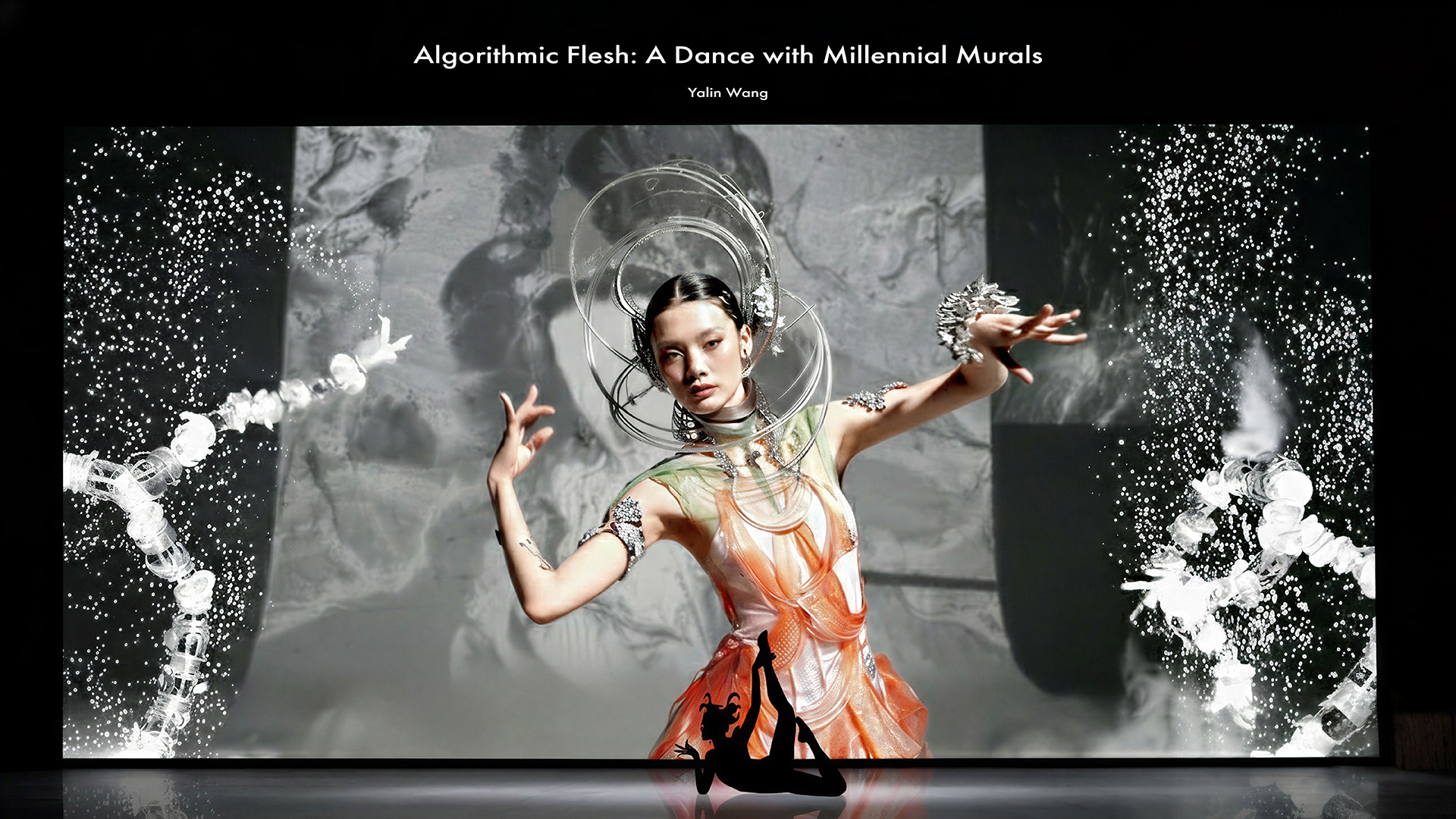
Algorithmic Flesh: A Dance with Millennial Murals
What happens when a sacred dance is silenced for a thousand years? In the Dunhuang...
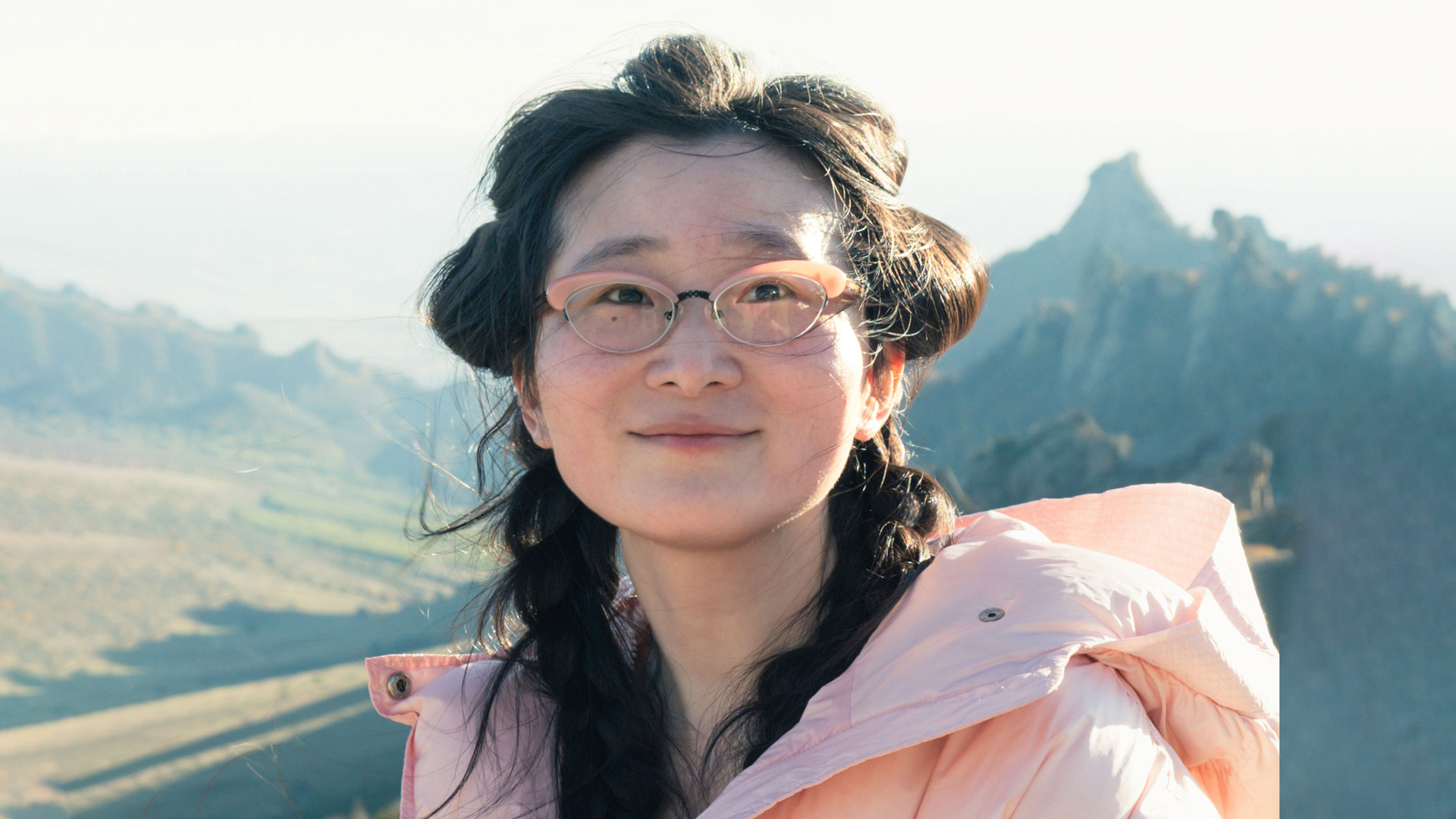
Yalin Wang is an artist and researcher whose work explores the intersection of cultural heritage, generative AI, and embodied interaction. Through projects such as Algorithmic Flesh, the research investigates how emerging technologies can move beyond preservation to revitalize cultural practices, ritual experiences, and embodied wisdom.
Thank you to the MUSE Creative Awards for this recognition. I am Yalin Wang, an artist and researcher, and currently a PhD candidate in Innovation Design Engineering at the Central Academy of Fine Arts (CAFA), Beijing.
My practice and research investigate the intersection of cultural heritage, generative AI, and “embodied interaction.” My entire academic journey has been rooted at CAFA, from my B.A. in Visual Communication Design to my M.A. in Design Criticism and Curatorial Studies, and now to my doctoral research.
This journey has been a progressive inquiry. It began with an interest in “how to create visuals,” evolved into “how to critically understand and curate visual culture,” and has finally settled on a more fundamental question: How can I use emerging technologies like AI not just to “preserve” my cultural heritage, but to “revitalize” the cultural practices, ritualistic experiences, and embodied wisdom embedded within it? Algorithmic Flesh is the embodiment of that inquiry.
The inspiration to submit Algorithmic Flesh was to share what I believe is a powerful new methodology with a broader international creative community. I believe the future of digital cultural heritage should not be about “static preservation,” but about creating “living ritual.”
The MUSE Creative Awards, which champions boundary-pushing, immersive, and experiential work, felt like the perfect platform to present my “Ritualistic Revitalization” framework.
Winning the Gold Award is a tremendous honor. Personally, it validates my cross-disciplinary exploration at the intersection of art and research. Professionally, it serves as a powerful affirmation of my core thesis: that even with a “broken lineage” of cultural heritage, technology and embodied participation can help forge profound, personal, and contemporary cultural connections.
The story begins with a question—and a profound loss.
The inspiration came directly from the Dunhuang Caves, a UNESCO treasure. Amid that breathtaking beauty lies a tragedy: a sacred dance has been “silenced for a thousand years.” Its memory, its dynamic wisdom, remains “trapped in static murals.” We are facing a reality where the living lineage is broken.
Algorithmic Flesh was inspired by the quest to answer this seemingly impossible question: “How can we reawaken a dance?” In today’s creative landscape, this project represents a necessary paradigm shift—from “passive viewing” to active, embodied participation.
We often speak about using technology to “preserve” heritage, but this frequently means flattening its living essence into a digital image. Algorithmic Flesh demonstrates that technology can instead serve as a bridge, inviting contemporary bodies to become the catalyst for rebirth, transforming a static archive into a flowing, deeply personal journey.
If 'Algorithmic Flesh' stands out, it is because of its core methodology.
Many digital projects dealing with Dunhuang heritage follow the path of 'digitizing the reconstruction'. They might motion-capture modern dancers performing a contemporary interpretation of the murals. This is valuable, but they are digitizing a '20th-century reconstruction' , an interpretive layer already centuries removed from the source.
My strategy was to 'bypass... the interpretive layer of modern reconstruction' entirely. I asked a deeper question: Can I use generative AI to engage directly with the 'latent kinesthetic intelligence' within the original murals themselves?
To do this, I introduced a novel interaction I call 'Somatic Prompting'. I don't just let you watch; I invite you to use your body as the 'key'. As you gesture, the AI, 'steeped in ancient aesthetics,' engages you in a 'co-creative dance'. It 'dreams the forgotten steps that bridge the classic poses' , fusing the 'ephemeral grace of the human body with the deep memory of the cultural archive'. It is not a reconstruction; it is a rebirth.
The greatest challenge was philosophical, not just technical: the weight of “authenticity.” When dealing with a “broken cultural lineage,” one can never claim to be 100% “reconstructing” the past.
This philosophical challenge manifested technically as the problem of “iconographic fidelity.” Generative AI is inherently prone to “hallucinations”; it can produce plausible but not strictly accurate details. This was especially evident in complex, symbolic features such as hand gestures (mudras), where current models still face limitations.
I addressed this challenge by reframing the project’s goal. I accepted that I was not attempting “reconstruction,” but rather “co-interpretation.” I began to see the AI’s “hallucinations” not as errors, but as creative provocations—what my research describes as “Productive Ambiguity.”
The system is not an AI teaching the “correct” dance. Instead, it becomes a hermeneutic dialogue between the participant and a cultural partner. By turning this technical limitation into a core philosophical tenet of the project, I was able to arrive at a meaningful solution.
In the long run, I truly hope this recognition from MUSE encourages the field of digital cultural heritage itself. I hope it inspires more museums, cultural institutions, and curators to look beyond the paradigm of “static preservation” and to bravely invest in, explore, and create living, embodied rituals.
For me personally, and for my academic home at the Central Academy of Fine Arts (CAFA), this award is a powerful affirmation of the “artist-researcher” model and my “Research through Design (RtD)” methodology. It demonstrates that rigorous academic inquiry can produce compelling, award-worthy art that resonates with the public. I hope this helps pave the way for more cross-disciplinary, research-based creative practice.
As for immediate changes, this recognition is very recent, but it has already been incredibly validating. It has sparked several meaningful conversations with peers and institutions who are equally passionate about the future of digital heritage. It is a powerful signal that this line of inquiry—this “somatic turn” I mentioned—is resonating with the wider creative community, which is perhaps the most meaningful opportunity of all.
As “Algorithmic Flesh” is a “Research through Design” project, audience feedback is not just a reaction; it is my most valuable data.
The most consistent feedback is surprise. People walk in expecting to watch an exhibit about Dunhuang; within seconds, they realize they are the exhibit’s core. I observed, again and again, the exact transformation I hoped for: the participant transforms from spectator into a catalyst for rebirth. They might start hesitantly, but when the “algorithmic dancer,” born of light and data, responds to them in a way that is both ancient and immediate, a co-creative dance begins.
My most memorable piece of feedback was from a participant who said, “I felt like I wasn’t looking at the mural, but that the mural was looking back at me and inviting me to dance.” This is exactly the profound personal meaning-making I aimed to foster—transforming static heritage into a flowing, deeply personal journey.
That’s a wonderful question. Based on my “Research through Design” process for “Algorithmic Flesh,” I would offer four key design principles that function as both strategies and mindsets:
Design for Somatic Legibility: The connection between the user’s body and the system’s feedback must be immediate and intuitive. This builds trust and immersion.
Embrace Productive Ambiguity: Don’t aim for perfect user control. Especially with AI, embrace the “accidents” and “hallucinations.” These ambiguities are sparks for co-interpretation and partnership, not errors.
Train for Aesthetic Partnership: Don’t rely on a generic AI model. I spent time fine-tuning my models on the specific aesthetic language of Dunhuang. Your AI should feel like a culturally informed partner, not just a tool.
Scaffold from Familiarity to Abstraction: Start with a simple, familiar interaction (like mirroring) to build user confidence. Your system can then guide them into more complex, abstract, and co-creative layers of interaction.
I believe we are at a thrilling inflection point. The wave of generative AI is the most visible change, but I believe the current dominant interaction—the “textual prompt”—is only the beginning.
The next, more profound evolution, I believe, will be the shift from textual prompts to “somatic co-interpretation.” A text prompt is explicit and denotative. Our body, by contrast, is tacit, ambiguous, and expressive. Using the body as the prompt opens an entirely new mode of human–AI collaboration.
I hope to position myself at the forefront of this “somatic turn” in HCI. My goal is to continue exploring how embodiment can become a core component of human–computer interaction. Through this work, I aim to integrate unique non-Western epistemologies—such as the kinesthetic wisdom embedded in Dunhuang murals—into our increasingly standardized digital systems, resisting cultural homogenization while enriching our collective digital future.
I understand that hesitation completely. My advice is to reframe the purpose of entering.
Especially when you are starting out, don’t see it as a competition to “win” or “lose.” Instead, see it as an opportunity to contribute to the academic and industry discourse. The core purpose of sharing work—whether it’s a research paper or an art project—is to share your findings, your methodology, and your unique perspective. A platform like MUSE provides an opportunity to have your voice heard and to learn from the feedback of the global community.
Your perspective is unique and valuable. Share it. Don’t let “limited experience” hold you back, because your new perspective might be exactly what the industry needs.
To all my fellow creatives, marketers, and advertising professionals, my message would be: design for the body.
We have spent decades mastering how to capture attention through a screen—the art of passive viewing. The next true frontier is how to engage the entire body—the art of active, embodied participation.
Whatever your medium—an installation, a website, or an ad campaign—ask yourself: how can this be transformed from a 2D viewing experience into a 3D embodied one? Our technology, including real-time pose estimation and generative AI, is finally ready. It is time to create experiences that do not just look good, but feel profound and build a much deeper, more lasting emotional connection.
While this award is a deeply personal honor, it stands on the foundation provided by my academic home, the Central Academy of Fine Arts (CAFA), which served as the entrant company for this project.
CAFA provided not only the resources, but more importantly, the fertile, cross-disciplinary scholarly environment that my “Research through Design (RtD)” methodology requires to flourish. This recognition is a testament to that supportive academic ecosystem.
I would say: “Algorithmic Flesh is a living ritual that invites you to use your own body as a somatic prompt to awaken the dormant kinesthetic knowledge embedded within millennial murals, transforming you from a passive spectator into a co-creator of cultural rebirth.”
I chose that sentence because it captures the three core elements of the project:
The Form: It is a living ritual, not a static exhibit.
The Method: It uses somatic prompting as the core interaction.
The Goal: It awakens dormant kinesthetic knowledge and transforms the spectator into a catalyst for rebirth.
This award is a major milestone, but it is also a starting point. My next steps are twofold: going into the wild and expanding the boundaries.
First, going into the wild. I plan to take Algorithmic Flesh from the controlled lab environment and conduct in-the-wild deployments. I want to introduce it into public settings such as museums or galleries to observe, over time, how the general public interacts with this living ritual.
Second, expanding the boundaries. The core methodology of Algorithmic Flesh—what I call “Embodied Reinterpretation”—is not limited to Dunhuang dance. It can be applied to any form of cultural heritage that is broken or static. I have already begun exploring how this framework can expand to other forms of heritage, such as calligraphy or traditional martial arts, activating the embodied and kinesthetic knowledge stored within those forms as well.
I am very excited about the future of this research. Thank you.