U Hues
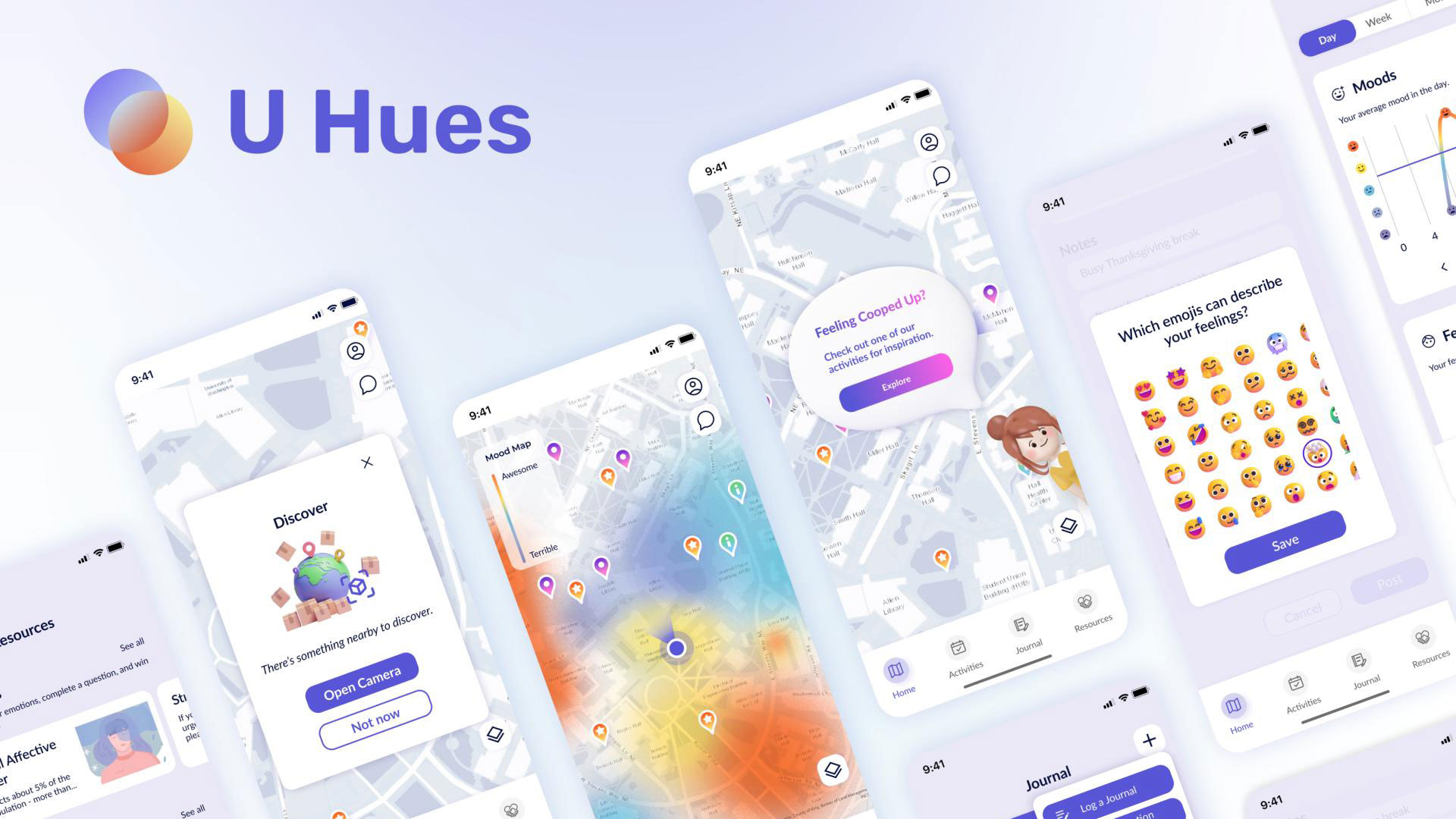
U Hues is a mood-mapping app addressing seasonal depression by turning proven supports—light, movement, and...

I am a multidisciplinary designer with over seven years of experience across UX design, digital media, and spatial design, and I currently work as an Experience Designer at Autodesk. My academic background spans Human Centered Design & Engineering, Landscape Architecture, and Architecture, which has shaped the way I approach problems through both systems thinking and human experience.
My background in the healthcare industry developed through both academic and professional work. In graduate school, I worked on several healthcare related projects, including a VR hearing aid simulator in collaboration with Seattle Children's Hospital, a capstone project focused on reducing the mental stress experienced by content risk analysts, and U Hues, a concept addressing seasonal depression.
I later worked as a UX designer and researcher for a healthcare company that provided in person and telemedicine services for people with disabilities, where I designed a patient profile management portal.
What motivated this initiative was the shared interest my team and I had in the mental health challenges that are especially visible in Seattle and other high latitude regions. We wanted to work on something that felt local, specific, and meaningful to us, rather than trying to address a health issue in a broad or abstract way.
Seasonal depression stood out because it is common, recurring, and often underrecognized. Many people experience the effects of long winters, early darkness, and social withdrawal without fully understanding what they are experiencing. U Hues was designed to respond to that gap. Its impact lies in helping people recognize symptoms earlier, feel less alone, and take small supportive actions before things become overwhelming.
In my current role as an Experience Designer II at Autodesk, I work on complex digital product experiences across user research, problem framing, interaction design, prototyping, design storytelling, and cross functional collaboration with product managers and engineers. Much of my work focuses on translating complex systems into experiences that feel clear, intuitive, and usable.
Although U Hues was not created as part of my current role, my professional design practice strongly influenced its development. I approach design not simply as interface creation, but as a way of shaping behavior, reducing friction, and helping people better understand complexity, a perspective that became central to the development of U Hues.
One of the most meaningful moments from the project came during research, when participants described seasonal decline in very ordinary language. Rather than identifying it as depression, they expressed it through everyday experiences such as staying indoors for days, feeling emotionally heavier, or not understanding why winter affected them so deeply each year.
That insight became central to the development of the project. The persona of Jerry was created to represent someone who may not actively seek formal treatment, but is quietly struggling and in need of support that feels approachable, private, and realistic.
During concept testing, it was especially encouraging to see participants respond positively to the ideas of anonymous connection and small outdoor prompts. It reinforced that the project was addressing a genuine emotional need rather than simply presenting a conceptual solution.
U Hues was inspired by a very specific condition: life in Seattle and other northern regions where winters can be long, dark, and emotionally challenging. My team and I were interested in mental health, but we did not want to create something generic. Instead, we wanted to respond to a condition grounded in real environments and lived experiences.
The message behind the project is that seasonal depression deserves greater visibility, and that support does not always need to begin in a clinical setting. Sometimes what people need first is a better bridge between awareness and action. Through U Hues, we wanted to show how small, thoughtfully designed moments such as movement, reflection, subtle connection, and easier access to support can make care feel more approachable and achievable.
One of the core creative decisions behind U Hues was using the map as the project’s organizing metaphor. Rather than treating mental health as a static dashboard or private log, the platform visualizes it as something shaped by place, time, and social connection. This approach helped the experience feel more spatial, grounded, and human centered.
The emotional layer of the map uses color and proximity to communicate mood in a subtle and intuitive way, avoiding an overly performative experience. AR based geocaching was also introduced not simply as a novelty, but as a creative way to encourage a proven behavioral support, spending time outdoors, through an experience that feels engaging and memorable. Overall, the visual language was intentionally designed to feel calm, approachable, and distinct from traditional clinical interfaces.
The project contributes by addressing mental health support at the stage before crisis. It raises awareness by helping people recognize emotional patterns they may otherwise dismiss or normalize, while encouraging behavioral change by reducing the friction around actions already known to help, such as spending time outdoors, reconnecting with one’s surroundings, and maintaining routine.
What makes this approach effective is that these behaviors are not presented as rigid instructions, but are instead integrated into a system that feels more approachable, contextual, and human. In this way, the project is not only about awareness, but also about making healthy action feel more accessible in everyday life.
The communication strategy focused on recognition rather than alarm. Instead of relying on medical terminology, the messaging centered around familiar winter experiences that people could immediately relate to, such as feeling unusually tired, sleeping more, craving comfort food, withdrawing from others, or not understanding why daily life suddenly feels more difficult.
Visually, the materials were centered around the mood map, which quickly communicated both the emotional and community driven aspects of the project. This approach made the concept easy to understand at a glance while also feeling distinct from the typical visual language often associated with wellness products. The goal was to create messaging that felt serious, approachable, and emotionally authentic.
Thank you. This recognition means a great deal to me because the project came from a place of genuine care and curiosity. It was not created to follow a trend, but to respond to a real condition that quietly and repeatedly affects many people.
Receiving this award also reinforces the idea that meaningful health related design innovation can emerge through interdisciplinary practice. Impactful healthcare solutions do not only come from medical devices or formal care systems, but can also be created through thoughtful experiences that help people take action earlier, feel less isolated, and navigate health in everyday life. That is something I care deeply about.
My winning work centers around a mood mapping app designed to help people address seasonal depression through anonymous mood sharing, short AR guided outdoor experiences, reminders, and access to curated mental health resources. The system was created to make evidence based support feel more immediate, approachable, and usable in everyday life.
I chose to enter this project because it represents the kind of health focused design I believe in most, work that is research informed, locally grounded, and behaviorally practical. Seasonal depression is a serious issue, yet it is often approached either too clinically or too casually. This project aims to occupy a more thoughtful middle ground that feels supportive, actionable, and respectful.
The biggest challenge was designing for trust. Mental health is deeply personal, and users can quickly disengage if an experience feels intrusive, performative, or unsafe. During the early stages of development, some ideas appeared helpful in theory but raised genuine concerns during testing, particularly around privacy and emotional vulnerability.
This pushed us to refine the experience beyond functionality alone. We had to carefully consider when to prompt users, how much information to surface, what should remain visible, and where control should be returned to the user. In a project like this, usability alone is not enough. If the experience does not feel respectful and emotionally safe, people are unlikely to engage with it.
Awards like this support me in two important ways. Externally, they create visibility and open opportunities for conversations across industries and disciplines. Internally, they encourage me to reflect more deeply on why a project matters, how effectively it communicates its value, and the kind of work I want to continue pursuing.
This recognition is especially meaningful because it exists within the health space. It reinforces my interest in designing for prevention, care, and emotional well being, while encouraging me to continue creating work that is both rigorous and human centered.
First, the health industry supports people during moments of vulnerability, which means design decisions carry significant emotional and ethical responsibility.
Second, it requires a careful balance between evidence and lived experience. A solution may be technically accurate, but still fail if it does not feel usable, dignified, or clear to the person receiving care.
Third, health is deeply systemic, with outcomes shaped not only by treatment, but also by access, environment,behavior, trust, and communication. This makes health design both highly complex and deeply important.
I come from China and have lived in the United States since 2019, which has allowed me to experience differences between the two healthcare systems from both personal and cultural perspectives. What stands out to me most is not only how healthcare is delivered, but also how differently mental health is understood, discussed, and accessed.
Across both contexts, I believe mental health remains an area where support can still fall short. For individuals with immigrant or international backgrounds, one of the greatest challenges is finding care that truly resonates, someone who understands not only the language, but also the cultural values, family dynamics, and emotional frameworks a person comes from.
I have seen firsthand how difficult that experience can be, and how strongly it can influence whether people choose to seek help at all. It has reinforced my belief that accessibility in healthcare is not only about availability, but also about cultural understanding, trust, and the feeling of being truly seen.
I believe the healthcare industry will continue moving toward prevention, personalization, and continuous support. More health related experiences will become integrated into everyday life rather than being limited to formal medical settings. This includes mental health, chronic condition management, and tools designed to support people earlier rather than later.
At the same time, I believe trust will become even more important. As healthcare products become increasingly data driven and intelligent, the key question will not only be what they can do, but also whether people understand them, trust them, and feel respected by them. The future of healthcare innovation will depend just as much on clarity and ethics as it does on technology.
I would recommend developing skills across three key areas. First, strengthen human centered research skills, as healthcare design requires careful listening, empathy, and strong ethical awareness. Second, learn how to interpret evidence and think critically about research studies, even without a formal medical background. Third, spend time understanding real world workflows through hospitals, clinics, community health systems, or patient services.
For designers in particular, I would strongly recommend studying accessibility, service design, and behavioral science. These areas are especially valuable because healthcare challenges rarely exist only at the interface level. More often, they are connected to broader systems involving decisions, constraints, emotions, and human behavior.
I am inspired by people who are able to balance rigor with humanity, mentors, researchers, designers, and leaders who engage deeply with complexity while never losing sight of the people their work ultimately serves.
I am also inspired by individuals who move thoughtfully across disciplines. My own path has connected architecture, spatial design, UX, and health related work, which has given me a deep appreciation for those who can bridge different fields in meaningful ways. They remind me that some of the most impactful ideas often emerge by crossing boundaries rather than remaining within them.
For me, the key is staying honest about the real problem. As a designer, it can be easy to become attached to solutions, but the strongest work often comes from continuing to listen, refine, and question what truly matters to people.
If I had one final thought, it would be this: meaningful impact does not always have to look dramatic. Sometimes the most important work is making one difficult step feel a little easier, one system a little clearer, or one person feel a little less alone.
I am grateful to see health awards recognize projects that operate beyond traditional clinical formats. There is tremendous value in designing for the spaces before treatment, around treatment, and beyond treatment, where awareness, habit, dignity, and accessibility all play important roles.
I hope more people continue exploring healthcare not only as a medical challenge, but also as a design challenge. When approached thoughtfully, design has the ability to make care earlier, clearer, and more human.