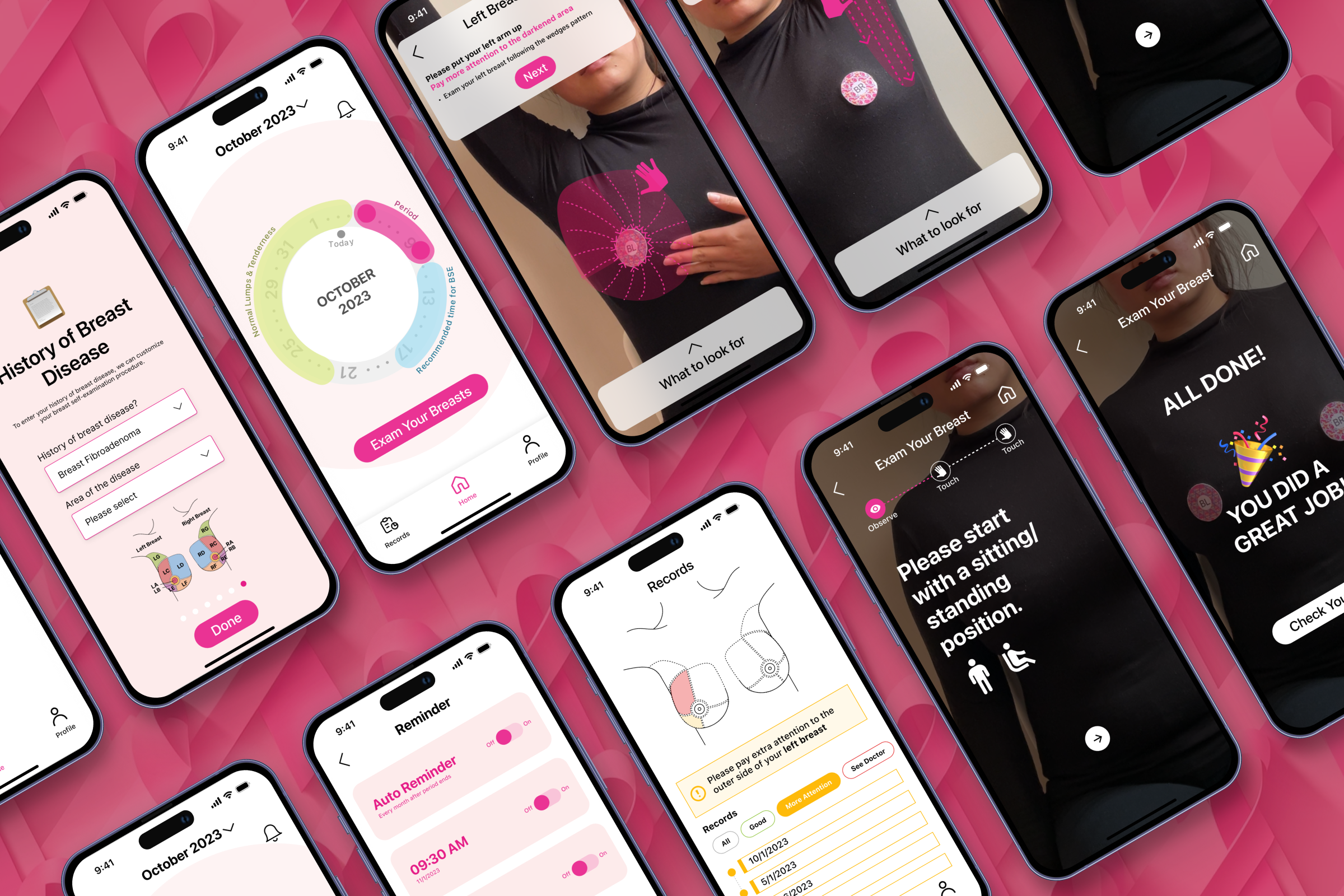
Palpa: AR-Integrated App for Breast Self-Examination
Project Description: Palpa is a groundbreaking FemTech solution that leverages Augmented Reality (AR) to revolutionize...

Designers Yijing (Jennie) Wang, Yijun (Claire) Huang, and Jinghan (Jenna) Wang bring together backgrounds in product design, HCI, and healthcare-focused UX to explore emerging technologies — together, they created Palpa: AR-Integrated App for Breast Self-Examination.
Yijing (Jennie): My name is Yijing (Jennie) Wang, and I am a product and UX designer based in New York. My background combines industrial design and digital product design, and I am particularly interested in using emerging technologies to improve healthcare accessibility and preventive care.
Yijun (Claire): My name is Yijun (Claire) Huang, and I am a UX designer based in the San Francisco Bay Area. My background is in Human-Computer Interaction, and I am particularly interested in bridging the gap between physical hardware and digital software through accessible, AI-driven experiences.
Jinghan (Jenna): My name is Jinghan (Jenna) Wang, and I am a UX designer based in Atlanta with a background in user-centered design and Human-Computer Interaction. I am passionate about applying design and technology to healthcare, creating solutions that enhance patient experiences and support more effective, empathetic care.
We submitted this project because preventive healthcare is an area where thoughtful design can make a meaningful impact. Winning this award is especially meaningful to us, as it recognizes the potential of design and technology to improve health awareness.
The project explores how augmented reality can guide users through breast self-examinations in a more intuitive and supportive way. It reflects an effort to make preventive health practices more accessible, private, and easy to follow.
What helped the project stand out was the integration of AR with clear instructional design. By visualizing guidance directly on the body in real time, the experience reduces uncertainty and helps users perform self-examinations with greater confidence.
One challenge was translating sensitive medical guidance into a digital experience that remained clear and respectful. We addressed this through careful user-centered design, prioritizing clarity, comfort, and privacy in the interface.
We hope this recognition helps bring greater attention to the role of design in preventive healthcare. In the long term, we also hope it encourages further exploration of how emerging technologies can support everyday health practices.
Many people responded positively to the idea that technology could make self-examinations easier and less intimidating. The most meaningful feedback has come from individuals who said the concept could help them feel more confident in monitoring their health.
Focus on real human needs. When a project begins with empathy, strong research, and a clear purpose, the work becomes far more compelling and meaningful.
The creative industry is evolving rapidly with technologies such as AR and AI. We are excited to continue exploring how these tools can be applied to solve meaningful problems in healthcare and other complex domains.
Awards can feel intimidating, but they are also opportunities to share ideas that matter. Even early-stage concepts can contribute to important conversations and inspire others.
Design has the power to make complex or sensitive experiences more approachable. We hope creatives continue to use their skills to address meaningful challenges that impact people’s lives.
We would like to dedicate this recognition to the mentors and collaborators who supported the research and development of this project. Their guidance played an important role in shaping its vision.
An AR-guided experience designed to help individuals perform breast self-examinations with greater clarity, confidence, and accessibility.
We are continuing to explore how design and emerging technologies can improve preventive healthcare experiences. We are excited to keep developing ideas that make health information and tools more accessible to everyone.